The Complete Guide to Outdoor Pickleball in Autumn Wind and Low Sun
Quick Answer: Autumn pickleball changes on four fronts: the ball becomes harder and less lively in cold air, wind becomes the dominant tactical variable, low sun makes overheads and serves genuinely hazardous, and cold muscles raise injury risk. Adjust by playing more percentage shots, taking the wind-disadvantaged side first, never tracking a lob into the sun, and warming up twice as long as you did in July.
Same court, same partner, same paddle. Your dinks are sailing, your third shot drops are landing in the kitchen or in the net with nothing in between, and you lost a lob in the sun and took one off the shoulder.
Nothing about your game deteriorated over three weeks. Four separate environmental variables changed, and each one has a specific answer.
Here is the complete version, one variable at a time.
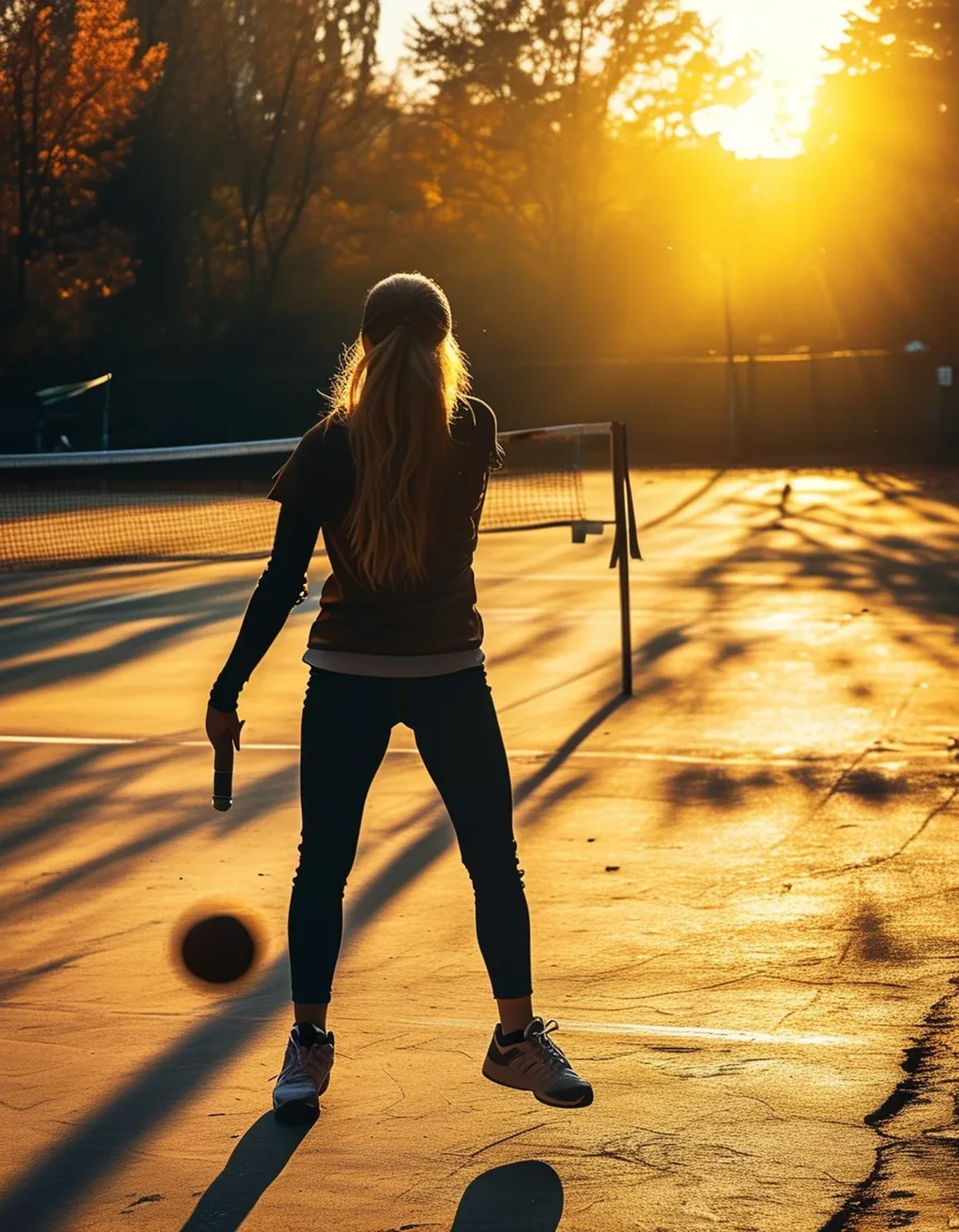
How cold air changes the ball and the bounce
This is the change nobody warns you about, and it explains the largest share of the “I lost my touch” feeling.
The plastic gets harder and less elastic as temperature drops. Outdoor pickleballs are injection-molded plastic, and below roughly 55°F the material stiffens noticeably. Below 45°F it stiffens a lot, and cracking becomes common — cold balls crack far more often than warm ones, which is why autumn play goes through balls faster.
The playing consequences:
- Lower bounce. A stiffer ball deforms less on impact and returns less energy. Balls sit down more, which means more shots at or below net height and more low volleys.
- Less pop off the paddle. Your usual swing produces a shorter ball. Drives that cleared the net in July catch the tape now.
- Denser air adds drag. Cold air is denser, so the ball decelerates more through flight. Combined with lower bounce, everything plays shorter.
The adjustments:
- Swing slightly bigger on drives and serves. Not harder — longer. You need more energy into the ball to get the same result.
- Expect to hit up more. With balls sitting lower, your dinks and drops start from a lower contact point. Bend your knees more; do not compensate by opening the paddle face, which is how dinks start popping up.
- Keep spare balls in a pocket or a warm bag. A ball kept near body heat plays measurably better. Rotate them between games.
- Retire cracked balls immediately. A cracked ball flies unpredictably and is the source of a lot of unexplained errors.
Playing the wind: the single biggest tactical variable
Autumn wind is gustier and less predictable than summer wind, and pickleball’s light ball makes it the most influential condition in the sport.
Read it before the first serve. Toss a few blades of grass, watch a flag, or watch the first few balls. Identify direction and, more importantly, whether it is steady or gusting. A steady wind you can play against. A gusting wind requires a wider margin on every shot.
On the downwind side (wind at your back):
- Everything travels further. Your drives go long, your lobs sail out, your serves run deep.
- Take pace off and add topspin. Topspin brings the ball down and is your main tool here.
- Aim shorter than feels correct. Target the middle of the box rather than the back.
- Dinks are the hardest shot. A dink with the wind behind it will push you into the kitchen. Play them softer and lower.
On the upwind side (wind in your face):
- Everything falls short. Drops land in the net, serves are shallow.
- Add pace and swing through more. This is the side to be aggressive from — drives hold up well into the wind.
- Lobs become a genuine weapon because the wind holds them up and drops them at the baseline.
- Expect balls to check up on you; be ready to move forward.
Crosswind is the hardest. Aim into the wind and let it bring the ball back. On serve, target the middle of the box rather than a line — a crosswind turns a good line serve into a fault.
The partnership adjustment: communicate more, not less. In wind, “yours” and “mine” have to be louder and earlier because the ball moves after the call.
Low sun, long shadows, and the overhead problem
The autumn sun sits far lower for far more of the playing day, and this is the one genuine safety issue on the list.
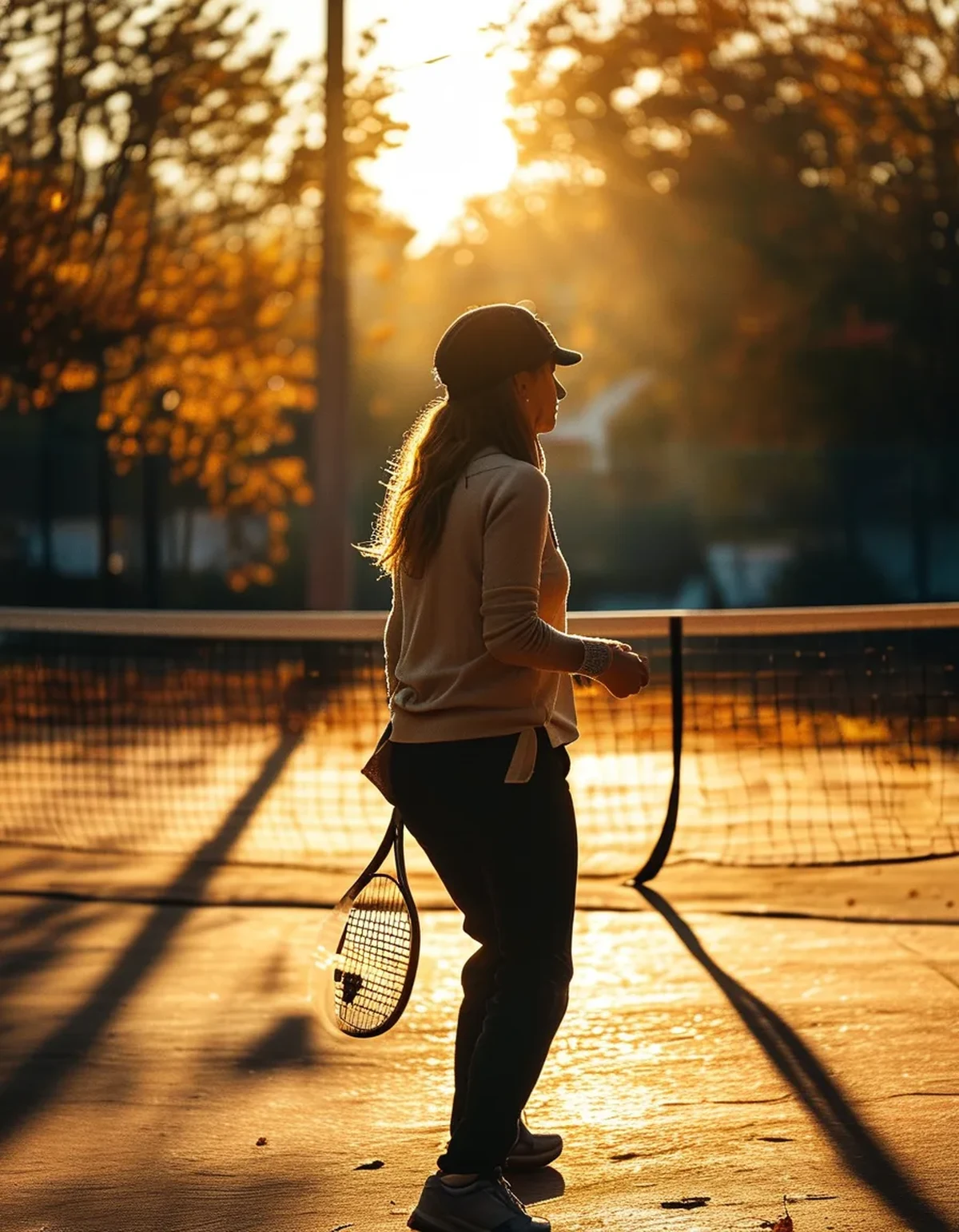
The overhead danger. Tracking a lob into a low sun is how people get hit in the face. The standard advice — shade your eyes with your non-paddle hand — is not sufficient with the sun at 20 degrees above the horizon.
- If you lose the ball in the sun, do not swing. Call it, move away, let it bounce. Losing the point is a fine outcome.
- Move laterally rather than backing straight up. Stepping two feet to the side often gets the sun out of your eyes entirely and is much safer than backpedaling blind.
- Let your partner take it when the sun is on your side. Establish this before the game, not during a rally.
The serve problem. Serving into a low sun is difficult, and receiving with the sun behind your opponent is worse.
- Change ends more often if you are playing socially. Alternating every game keeps it fair.
- Take the sun side first if you get the choice. You will be fresher and more able to handle it early.
- A visor beats sunglasses for many players. A brim blocks the sun without darkening the ball, and in the deep shadows of a low-sun court, dark lenses become a liability.
Long shadows. Court shadows from fences, posts, and trees create high-contrast patches that make the ball hard to track as it crosses in and out. Expect a couple of mishits per game from this and do not read too much into them.
Warming up when it is 48 degrees
Cold-weather injury risk in pickleball is real and mostly preventable. The sport involves explosive lateral movement, sudden stops, and overhead reaching — all of which are far riskier on cold tissue.
Double your warm-up time. If you did five minutes in summer, do ten to twelve now. This is the least popular and most important item in this guide.
The sequence that works:
- Three to five minutes of general movement first. Brisk walking, easy jogging, arm circles. Raise your core temperature before you do anything sport-specific.
- Dynamic mobility, not static stretching. Leg swings, lunges with a rotation, side shuffles, arm swings. Static stretching on cold muscle does not reduce injury risk and can reduce power.
- Progressive hitting. Start at the kitchen with soft dinks. Move back gradually. Do not start with drives.
- Shoulder-specific work before any overheads. Arm circles, band pull-aparts if you have one, and a few easy overhead motions with no ball.
Stay warm between games. This is where people actually get hurt — cooling down completely on the sideline and then starting a game at full intensity. Keep a layer on when you are not playing and put it back on immediately after.
Watch the calf and Achilles specifically. The explosive push-off in a cold calf is the classic autumn pickleball injury. If you have a history there, add calf raises to your warm-up and take the first game at reduced intensity.
What to wear, and the layering problem specific to court sports
Court sports have a layering problem most guides ignore: you alternate between high intensity and standing still every 30 seconds.
Base layer that wicks, always. A long-sleeve technical base at 45-58°F. Cotton is the wrong answer — it holds sweat, and standing between points in a wet cotton shirt at 50°F is how you get cold and stiff.
A mid layer you can play in. A quarter-zip or light long-sleeve that does not restrict the shoulder. Test the overhead motion before you commit to it — many casual layers bind at the shoulder.
An outer layer for between games only. A jacket you take off to play and put on immediately after. This is the single most useful item in an autumn pickleball bag.
Gloves are a real consideration. Cold hands mean poor paddle feel and reduced grip. Thin, tacky sport gloves work for some players; others prefer to keep hands in pockets between points. Either beats numb fingers.
Grip changes in the cold. Overgrips get slick when cold and damp, and sweat behaves differently. Bring a spare overgrip in autumn — it is a cheap fix for a mysterious loss of control.
Shoes matter more. Autumn courts are damp in the morning and covered in leaves and pollen residue, both of which are slippery. Worn-out court shoes on a damp court is a genuine ankle risk. Check your tread before the season.
Court conditions: damp surfaces, leaves, and morning play
The court itself changes, and it accounts for more errors than players credit.
Morning dew is the main hazard. An outdoor court can stay damp until mid-morning in autumn, and a damp acrylic surface is significantly more slippery than a dry one — particularly at the kitchen line where you make quick direction changes.
- Test the surface before you play. A few hard lateral steps will tell you.
- Play later in the morning where you can. An hour makes an enormous difference.
- Towel the worst patches. Especially the kitchen line and behind the baseline.
Leaves are not just cosmetic. A leaf under your foot during a lateral push-off behaves like ice. Clear the court properly, and re-clear between games on a windy day — it takes 60 seconds and prevents the season’s most common fall.
Ball marks and pollen. Autumn brings a fine layer of organic debris that makes the surface dusty and slick. If the court has not been played on in days, a quick sweep genuinely improves grip.
Watch the net tension. Temperature changes affect net height slightly and outdoor nets sag over a season. If the ball is clearing by less than it should, check the net before you rebuild your swing.
Shorter daylight means shorter sessions. Plan for the light, and be aware that the last 30 minutes before sunset is when the low-sun problem is at its worst and when fatigue is highest — a bad combination for both errors and injuries.
FAQ: Autumn Pickleball Questions, Answered
At what temperature should I stop playing outdoors?
There is no hard cutoff, and most players continue comfortably into the 40s with proper layers. The real limits are surface conditions — never play on a court with any ice or frost — and ball behavior, since balls crack readily below about 40°F. Below that, indoor play with an indoor ball is usually more enjoyable anyway.
Should I switch to a different ball in cold weather?
Some players use a softer outdoor ball in cold conditions, and it does reduce cracking and improve feel. Check what your group or league uses first, since mixing ball types makes it hard to calibrate. At minimum, keep balls warm between games — it makes more difference than most people expect.
How do I stop my dinks popping up in the wind?
Usually it is compensation rather than technique. When balls sit lower and the wind pushes them, players open the paddle face to lift the ball, which sends it up. Instead, get lower with your knees, keep the paddle face more neutral, and shorten the stroke. Contact the ball out in front and let the low body position do the lifting.
Is autumn a good time to work on specific skills?
It is one of the best. Wind and low bounce both punish loose technique and reward the fundamentals — soft hands, patient dinking, disciplined shot selection. Players who train through autumn conditions frequently find their game noticeably sharper in spring, because the conditions forced precision that summer play never demanded.
TL;DR:
- Cold makes the ball harder and less lively and the air denser — everything plays shorter, so swing longer and expect low bounces.
- Wind is the dominant variable: take pace off downwind, add pace upwind, aim into a crosswind, and communicate louder.
- Never track a lob into a low sun. Move laterally, call it off, or let it bounce. A visor beats dark lenses.
- Double your warm-up, stay warm between games, and watch the calf and Achilles specifically.
- Wicking base layer, a playable mid layer, a jacket for between games, and a spare overgrip.
- Clear leaves, test damp surfaces, and plan sessions around the shorter daylight.
Autumn conditions punish sloppy technique, which is exactly why they are worth playing through. Adjust for the four variables and your level holds — and the fundamentals you are forced to sharpen show up next spring.
See It in Motion
Seen here: UPF 50+ Adjustable A-Line Running Skort with Pockets — shop it on bubblelime.com
Keep Reading
This article is for general informational and styling purposes only. Fit, sizing, and product availability may vary.