Complete Guide: Why Your Backhand Dink Breaks Down Before Your Forehand
Quick Answer: The backhand dink has a shorter lever, a weaker stabilising structure at the wrist, and a much narrower margin for contact point error than the forehand. As forearm fatigue accumulates, the wrist gives first, the paddle face opens, and the ball floats. The most effective fixes are a continental-to-slightly-backhand grip, contact further in front, and a ready position that stops you reaching.
Games one and two are fine. By game three, your backhand dinks are sitting up just enough for your opponent to attack, and you are losing points you were winning an hour ago.
Your forehand dink is doing exactly what it did at the start.
This asymmetry is close to universal at the 3.0 to 4.0 level, and it is not primarily a technique problem — it is a structural one that shows up as a technique problem once you are tired.
Why is the backhand structurally weaker?
Three separate reasons, and they compound as the session goes on.
The lever is shorter. On the forehand, your arm can extend and the paddle sits at the end of a long, stable chain from shoulder through elbow to wrist. On the backhand, the paddle is on the opposite side of your body, and the geometry forces a more compact position with less reach and less room to adjust.
The stabilising musculature is weaker. Holding the paddle face steady against ball impact on the backhand side relies on the wrist extensors and the small stabilisers of the forearm. These are substantially weaker and fatigue substantially faster than the flexors and the larger muscles that stabilise a forehand.
This is the same anatomical reality behind tennis elbow, and it is why backhand-side overload is such a common source of elbow pain in racquet sports.
The margin for error is narrower. On a forehand dink, contact can vary by several inches without much changing, because the arm can adjust in flight. On the backhand, the paddle face angle is much more sensitive to contact position. A contact point two inches too close to your body opens the face measurably, and an open face on a dink is a pop-up.
Add the fatigue curve. Forearm stabilisers under repeated low-level load — which is exactly what a long dink rally is — fatigue on a timescale of tens of minutes. By game three you have played several hundred dinks, and the muscles holding your backhand face steady are the first to give.
What exactly goes wrong as you tire?
A specific, predictable sequence. Recognising which stage you are at tells you what to fix.
Stage 1: The paddle face opens slightly. Fatigued wrist extensors allow the paddle to drop back a few degrees. The ball starts landing deeper in the kitchen rather than short. Nothing looks wrong yet.
Stage 2: Contact point drifts backward. As reaction speed drops, you contact the ball closer to your body instead of out in front. This is the single most damaging change, because contact behind the ideal point both opens the face further and removes your ability to control depth.
Stage 3: You start using the wrist to compensate. Feeling the loss of control, most players add a small wrist flick to recover pace and direction. Wrist action is the least repeatable part of the stroke, so consistency collapses and the misses get bigger.
Stage 4: You reach instead of moving. Legs are tired too, so instead of stepping to the ball you extend the arm. Reaching puts the contact point further from your centre, which magnifies every problem above.
Stage 5: The pop-up. Open face plus late contact plus wrist plus reach. The ball sits up, your opponent attacks, and the point is over.
The useful diagnostic: watch where your dinks are landing, not whether they are going in. Dinks creeping deeper in the kitchen is the earliest warning, and it appears well before anything is obviously wrong. That is the moment to make an adjustment, not three games later.
What grip should you actually be using?
A continental grip, or very slightly toward the backhand side of it — and this is where most players lose the argument before they start.
Continental — the so-called handshake grip — places the base knuckle of your index finger on the top bevel or just to the backhand side. It is the standard recommendation for pickleball because it lets you play forehand and backhand without changing grip, which matters enormously in fast kitchen exchanges where there is no time to switch.
Why an eastern forehand grip fails on the backhand dink: it naturally opens the paddle face on the backhand side, and you have to actively compensate with your wrist to close it. That compensation is a continuous low-level muscular effort — and it is exactly the effort that fails first when you are tired.
Players who report the backhand dink as their weakest shot are very frequently holding a forehand-biased grip and fighting it all session without knowing.
The small adjustment worth trying: rotate the grip a few degrees further toward the backhand from continental. This closes the backhand face slightly at rest, so holding it square requires less active work. You give up a small amount of forehand comfort and gain a backhand that does not degrade. For most players at the kitchen line, that is a good trade, because more balls come to the backhand side.
Grip pressure matters as much as grip position. On a scale of 1 to 10, dinking should be around a 3 or 4 — firm enough to hold the face, loose enough to absorb pace. Most players grip at 7 or 8 without realising, and a tight grip fatigues the forearm several times faster while also transmitting more shock to the elbow.
The check: if your forearm is pumped after a session, you are gripping too tightly. That single change often resolves both the fatigue and the elbow discomfort.

Where should the contact point be?
Out in front, and further in front than feels natural — this is the technical correction with the largest payoff.
The target: contact roughly level with or ahead of your front foot, with the paddle visible in your peripheral vision without turning your head. If you cannot see the paddle at contact, it is too far back.
Why in front matters so much on the backhand:
- The paddle face is more stable when the arm is extended in front than when it is folded in toward the body
- You can see the ball meet the paddle, which improves adjustment
- It builds in margin — if you are slightly late, you are still contacting at an acceptable point rather than behind
The drill that fixes it: stand at the kitchen line and dink cross-court backhand only, with the specific instruction to contact every ball where you can see it. Not to hit better, not to hit lower — just to see contact. Most players find this immediately changes both depth and consistency, and it is a cue that survives fatigue better than any technical instruction.
The ready position that makes it possible:
- Paddle up and out in front, roughly chest height, tip up
- Paddle slightly on the backhand side of your body’s centre line. This is the counterintuitive part: more balls come to your backhand at the kitchen than to your forehand, and starting neutral means every backhand is a movement while every forehand is already covered.
- Weight forward on the balls of your feet, knees soft
- Both hands on or near the paddle to reduce the load on the paddle arm between shots
The legs point that most players skip: dinking low should come from bending your knees, not from dropping the paddle head. Bending at the waist raises the paddle face and produces exactly the pop-up you are trying to avoid, and it is what tired players default to because it is less work than bending the knees.
What Nobody Tells You About Backhand Fatigue
You can train it directly, and almost nobody does — most players practise dinks in a way that avoids the problem entirely.
The typical practice pattern is mixed dinking, alternating forehand and backhand as the ball comes. That distributes the load and means the backhand stabilisers never accumulate enough fatigue to reveal the weakness. You practise in the condition where your backhand works and play in the condition where it does not.
The specific training that transfers:
- Backhand-only dink rallies, 5 minutes continuous. No forehands, even if you have to step around. This will get uncomfortable in the forearm around minute three, and that discomfort is the point — it is the exact fatigue state your backhand fails in during game three.
- Then play a game immediately afterwards. Practising while fresh does not prepare you for the state where it breaks.
- Grip strength and forearm endurance work off court. Wrist extensions with a light weight — 2 sets of 15 per side, twice a week — and a rubber band finger extension exercise. The extensors are almost never trained directly and they are what fails.
The elbow warning worth taking seriously: persistent pain on the outside of the elbow is lateral epicondylitis, and in pickleball it comes primarily from backhand-side overload, tight grip, and a paddle that is too heavy or too head-heavy. It is much easier to prevent than to resolve. If you have it, the grip pressure fix and a lighter paddle are the first two things to change.
Equipment worth checking:
- Paddle weight. Heavier paddles are more stable but fatigue the forearm faster. If your backhand degrades within a session, a lighter paddle is a legitimate fix rather than an admission of anything.
- Grip size. Too small a grip means you squeeze harder to control it, which accelerates everything above. Most players are on a grip that is slightly too small.
- Balance. A head-heavy paddle increases the torque your wrist must resist on every contact.
This is general information, not medical advice — persistent elbow pain deserves proper assessment.
How do you manage it during a session?
Recognise the stage, make one adjustment, and use the structural options available to you.
Early warning response, at stage 1 or 2:
- Reset your grip pressure consciously. Say it to yourself between points. This alone frequently buys another two games.
- Move your ready position further to the backhand side. If your backhand is degrading, cover it better rather than reaching for it.
- Recommit to contact in front. One cue, repeated: see the paddle.
Mid-session, at stage 3 or 4:
- Use more forehands. Stepping around a backhand dink is entirely legitimate and good players do it constantly. It costs a little court position and buys you your better shot.
- Take some pace off deliberately and aim for the middle of the kitchen rather than the sideline. Losing a little placement is much cheaper than a pop-up.
- Shake out the forearm between points. Ten seconds of hanging the arm loose genuinely helps.
Between games:
- Wrist extensor stretch: arm out, palm down, gently pull the fingers back, 30 seconds each side, twice. Quick and effective.
- Hydrate. Forearm fatigue and cramping both worsen with dehydration and this is easy to under-do on a cool autumn day when you do not feel thirsty.
The strategic option nobody uses enough: if your backhand dink is the weakness and your partner’s forehand covers that side of the court, discuss switching sides between games. This is a normal doubles adjustment and it directly addresses the problem, and most recreational pairs never consider it.
FAQ: Backhand Dink Questions, Answered
Should I use a two-handed backhand dink?
It is a legitimate option and it is increasingly common. Two hands provide much more stability and dramatically reduce forearm fatigue, at the cost of reach. If your backhand degrades within a session, a two-handed dink for anything you can reach comfortably is worth trying — many strong players use one hand for wide balls and two for anything closer.
Is my paddle too heavy?
If your backhand specifically degrades over a session while your forehand does not, weight is a reasonable suspect. Try a paddle 15 to 20 grams lighter for a session and see whether the game-three decline changes. Stability matters, but not if you cannot hold the face steady by the end.
Why do my dinks pop up more outdoors in autumn?
Wind is the main factor — a headwind lifts a soft dink noticeably. Cooler air also makes the ball slightly harder and less lively, which changes the pace you need. And cold hands grip harder, which accelerates forearm fatigue. All three push in the same direction.
Should I just avoid my backhand?
Not as a long-term plan, but stepping around it during a session when it is degrading is sound tactics. Fix it in practice with backhand-only rallies; manage it in games with positioning and shot selection.
TL;DR: The backhand dink fails first because it is structurally weaker, not because your technique is worse.
- Shorter lever, weaker wrist extensors, and a much narrower margin for contact point error than the forehand.
- The failure sequence: face opens → contact drifts back → wrist compensates → you reach → pop-up.
- Earliest warning is dinks landing deeper in the kitchen, well before anything looks wrong.
- Use a continental grip or slightly backhand of it, at grip pressure 3 to 4 out of 10.
- Contact in front — if you cannot see the paddle at contact, it is too far back. Bend the knees, not the waist.
- Ready position should sit slightly on the backhand side, because more kitchen balls arrive there.
Practise backhand-only dink rallies for five continuous minutes, then play immediately. Practising fresh does not prepare you for the state where the shot actually breaks.
See It in Motion
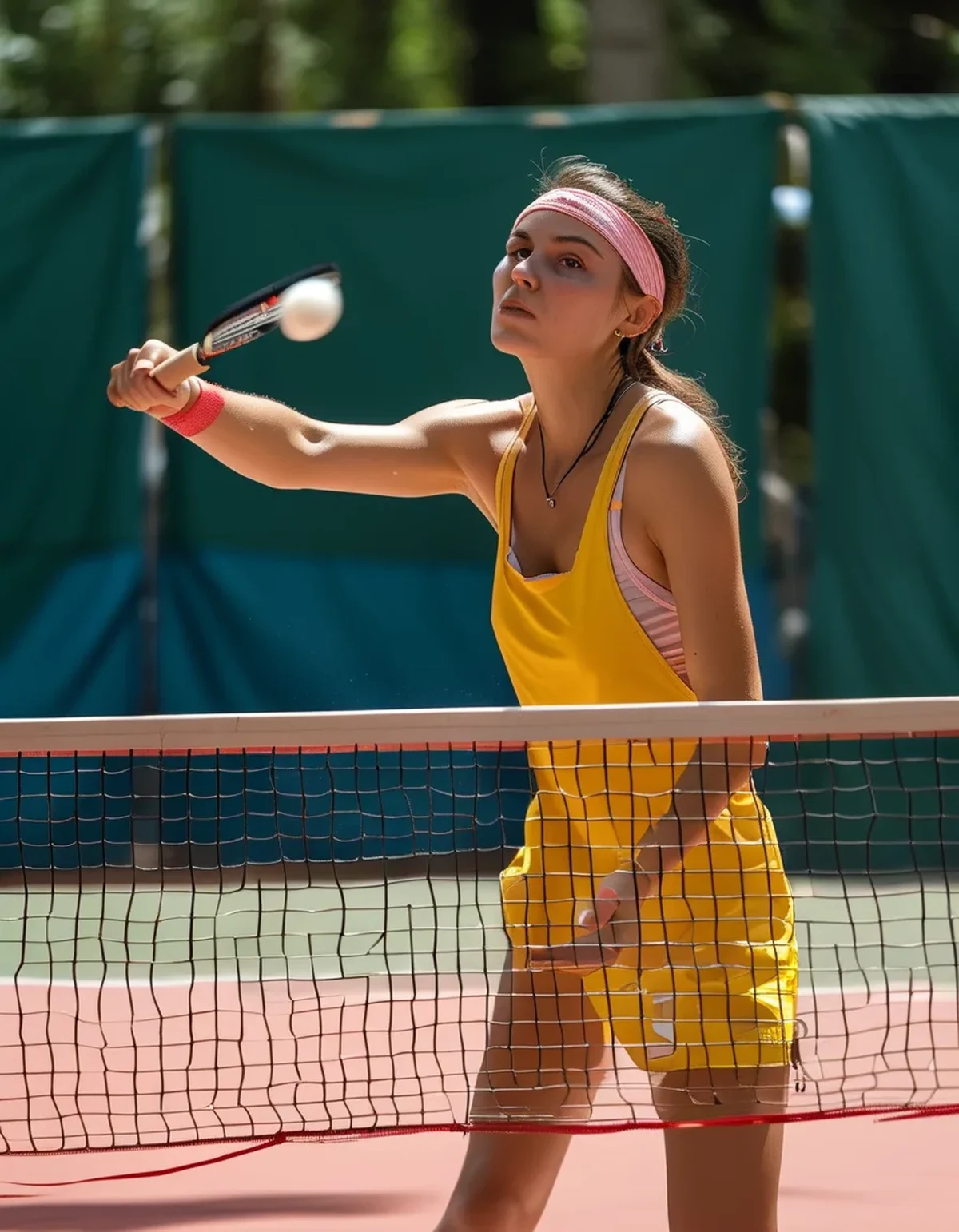
Seen here: UPF 50+ Pleated Running Skort with 26” Leggings & Pockets — shop similar styles on bubblelime.com
Keep Reading
This article is for general informational and styling purposes only. Fit, sizing, and product availability may vary.