Why the Return of Serve Decides More Points Than Your Serve Ever Will
Quick Answer: In pickleball the serving team must let the return bounce, which means the returning team gets to the kitchen line first almost every time - if the return is deep enough to buy the time. A deep return pushes the serving team back, forces a difficult third shot from behind the baseline, and hands the returning team the net position that wins most points. A short return gives all of that away instantly. Depth matters far more than pace, angle or spin on this shot.
You have spent your practice time on serving, because serving feels like the shot you control.
The serve wins you very few points. The return decides who gets to stand where the points are actually won.
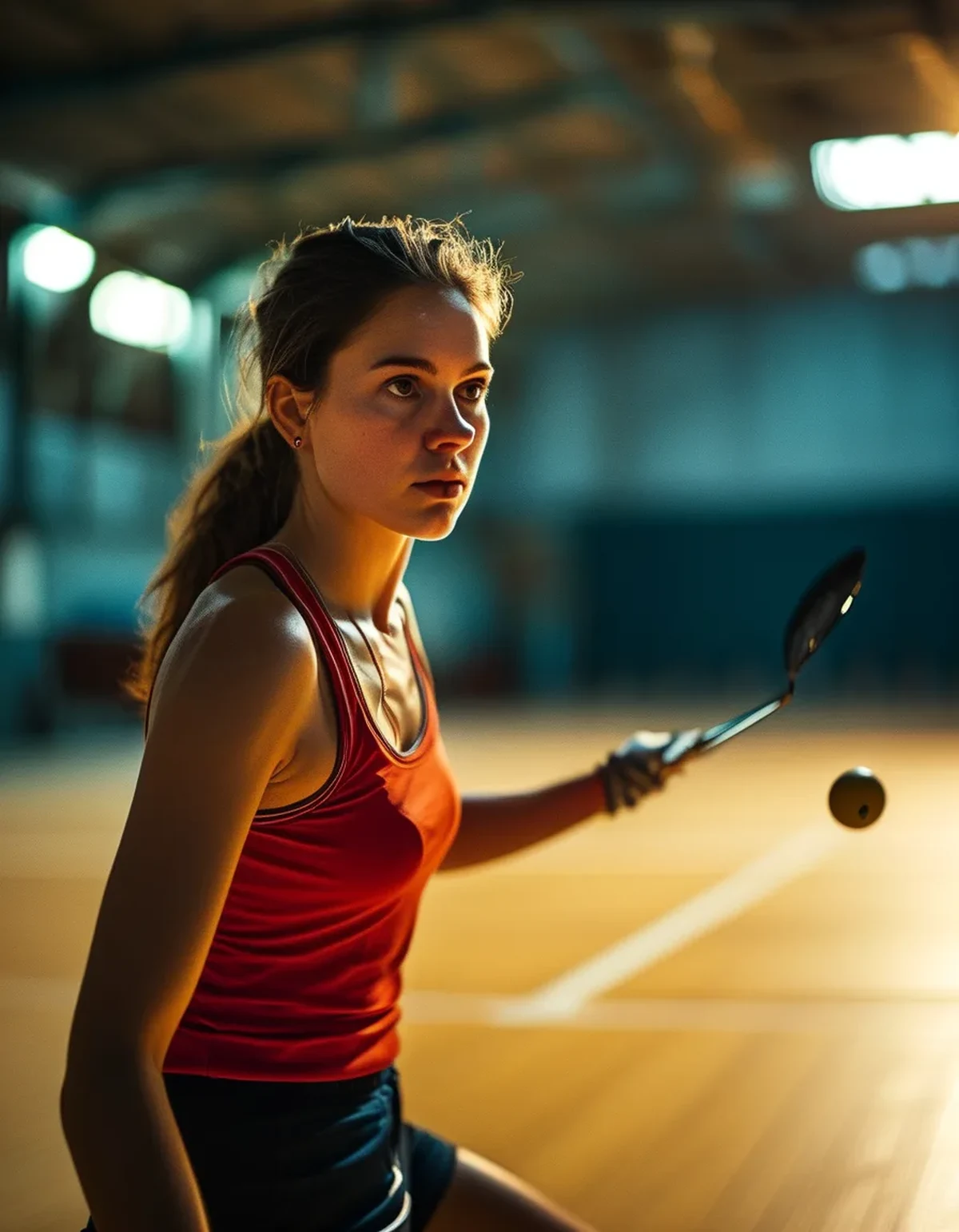
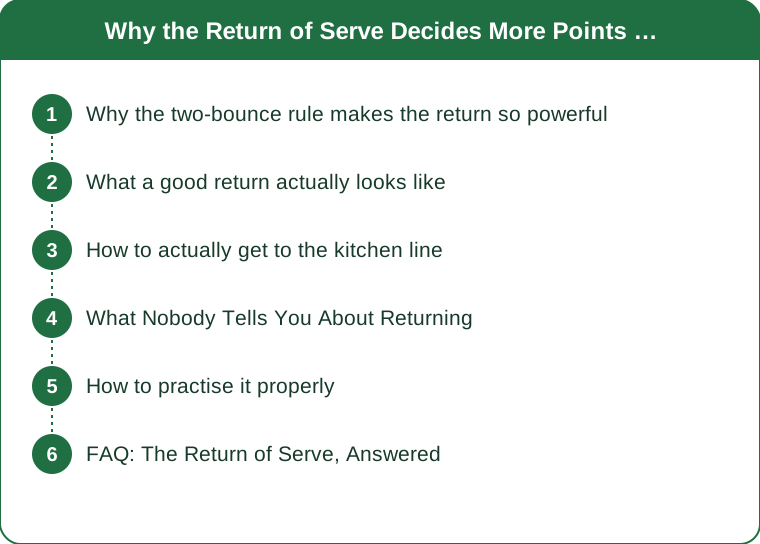
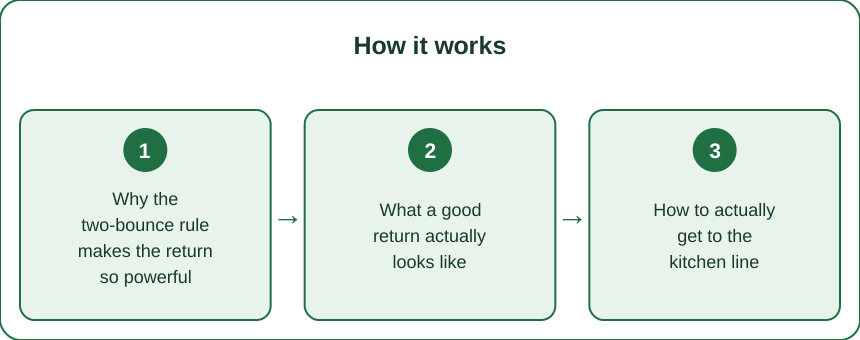
Why the two-bounce rule makes the return so powerful
The serve must bounce, and the return must bounce. That is the rule that shapes the entire structure of a pickleball point and it advantages the returning team in a way that is not obvious until you see it.
The returner hits and moves forward immediately, because their next shot does not have to bounce. They arrive at the kitchen line while the serving team is still waiting for the ball to land.
The serving team is stuck behind the baseline, waiting for the return to bounce before they can hit the third shot. They cannot advance until they have hit it, and they have to hit it from the back of the court.
Net position wins points at every level of pickleball. The team at the kitchen line hits down; the team at the baseline hits up. That geometry decides a large share of rallies before anyone makes an error.
A deep return maximises this advantage by pushing the serving team as far back as possible, which lengthens their third shot and their journey forward.
A short return destroys it entirely. The serving team steps in, hits an aggressive third shot from mid-court, and arrives at the kitchen line alongside or ahead of you - which converts a structural advantage into a neutral or losing rally.
Which is why depth is the only thing that really matters on this shot, and why pace, angle and spin are distractions from the one variable that decides the point.
What a good return actually looks like
Deep - within the last few feet of the court, aimed at the baseline. If you are choosing between hitting harder and hitting deeper, always choose deeper.
High enough to give yourself time. A return with some height and arc takes longer to arrive, which buys you the seconds you need to reach the kitchen line before the third shot comes back.
This is counterintuitive for players coming from tennis, where a low fast return is the aggressive choice. In pickleball a slower, higher, deeper return is more effective because time to move forward is the asset.
Aimed at the weaker player, or at the backhand. Once depth is reliable, target selection is the next lever - and the backhand of the weaker opponent is the standard answer.
Down the middle is a strong default in doubles, because it creates hesitation between partners and reduces the angles available for the third shot.
And consistent, every time. An unforced error on the return gives away a point with no rally at all, which is the worst possible outcome for a shot you had time to prepare for.
Aim for the safest version that is still deep. A return landing three feet inside the baseline every time beats one that clips the line half the time and goes long the other half.
Contact point matters more than swing size. Meeting the ball out in front, with the paddle face slightly open, produces the arc and depth you want without needing a big backswing. A late contact point behind the body is what turns a planned deep return into a short floater, and it is the most common technical cause of returns that land mid-court.
Use a continental or slightly open face and let the paddle do the lifting. Trying to generate depth by swinging harder flattens the trajectory, which shortens the flight time - the opposite of what you need. Depth comes from a longer, smoother swing path through the ball rather than from paddle head speed.
Recover your paddle to a ready position immediately after contact. A paddle still finishing its swing while you run forward is a paddle that is not ready for a fast third shot at your feet, and the third shot at your feet is exactly what a good serving team will hit.
How to actually get to the kitchen line
Start further back than feels natural. Returning from a step or two behind the baseline lets you move forward through the shot rather than being pushed backward by a deep serve.
Move through the ball, not after it. Your momentum should already be heading forward as you strike, which is what makes reaching the kitchen line possible rather than a sprint.
Take a split step as your opponent hits the third shot, wherever you have got to. Being balanced at mid-court beats arriving at the kitchen line off-balance.
If you cannot make it all the way, stop and split. The transition zone is uncomfortable, and being caught moving through it is far worse than being stopped and ready inside it.
Communicate with your partner about who is where. In doubles both players should be moving up together, and a staggered pair is easy to attack down the middle.
Practise the movement, not just the shot. Hitting returns from a stationary position in practice teaches a habit that does not transfer, because the whole value of the return is what it lets you do afterwards.
And do not admire the return. The most common error at intermediate level is hitting a good deep return and watching it, which costs the two seconds that were the entire point of hitting it deep.
Take a direct line rather than drifting sideways. Players who return from the corner often run forward on a diagonal, which leaves the middle open and adds distance to the journey. Move straight up the court you are responsible for, and let your partner cover theirs.
Expect to arrive slightly late for the first few weeks. The movement pattern is a habit rather than a fitness problem, and the fix is starting earlier rather than running faster. Most players who feel they cannot make it to the line are actually starting their move half a second after the ball has left the paddle.
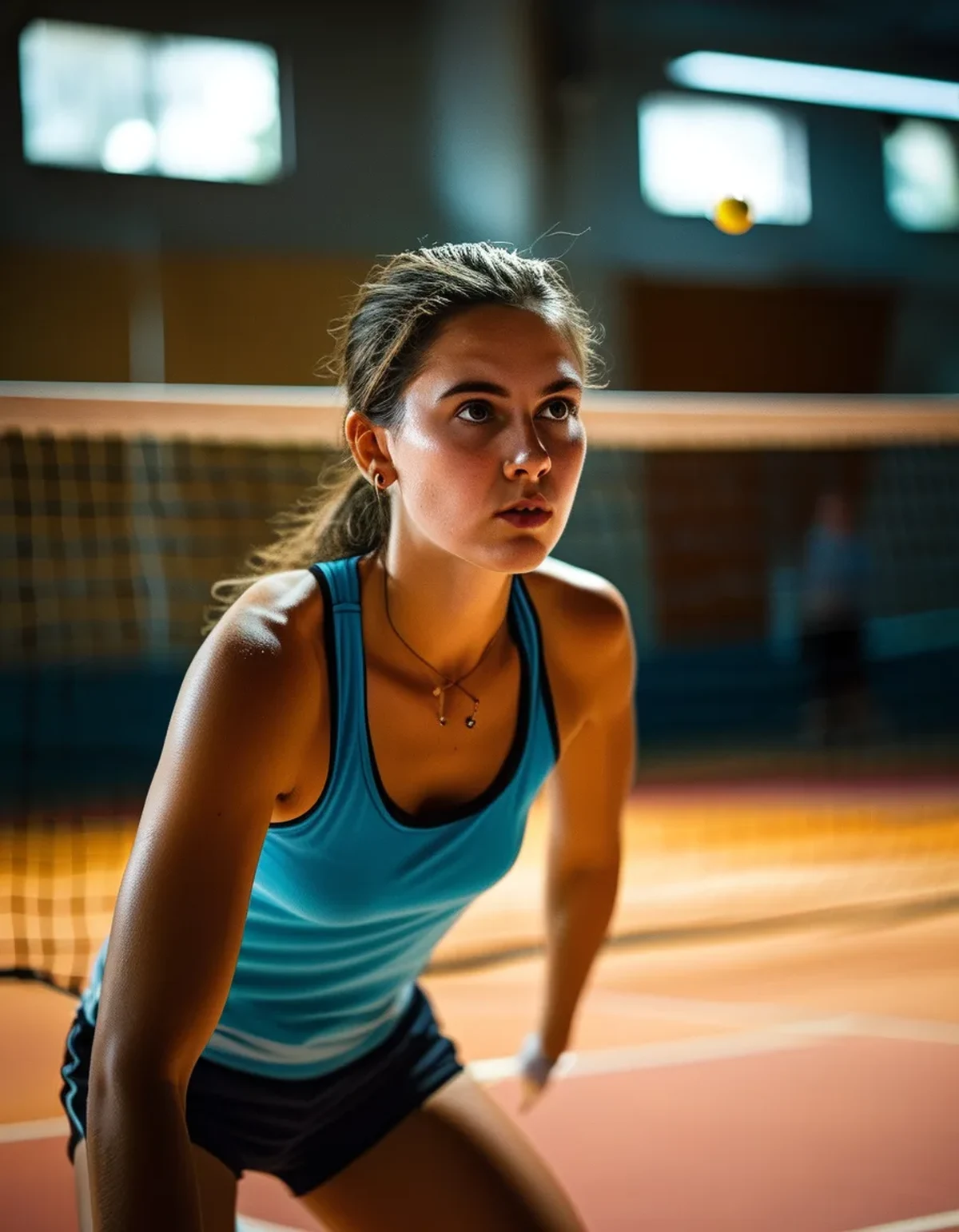
Watch the third shot from a low, wide stance. Arriving at the kitchen line upright and narrow means the first ball at your feet ends the rally. Knees bent, paddle up at chest height, weight on the balls of the feet - the position matters as much as the arrival.
What Nobody Tells You About Returning
The return is the only shot in pickleball you always have time to prepare for. You know it is coming, you know roughly where from, and you can set your feet. No other shot in the game offers that, which makes it the highest-return practice investment available.
Most recreational players return too short and too hard, which is the exact combination that gives away the advantage the rules handed them.
Returning deep is easier than returning hard, because it needs a longer swing and less precision rather than more of both.
The serve itself is deliberately constrained by the rules, which is why it wins so few points directly. Practising serves past basic consistency and depth has a low ceiling on improvement.
The third shot drop gets all the attention because it is the difficult, glamorous shot. It is only difficult because the return was deep - a short return means the serving team never needs to drop at all.
Wind changes return depth more than any other shot, since the ball spends longer in the air. Outdoor players should expect to adjust target depth by several feet in a breeze.
And returning is where older or slower players can be most effective, because it rewards placement, patience and consistency rather than speed. It is the most level part of the game.
How to practise it properly
Feed yourself serves with a partner and return only for depth, with a target zone marked three feet inside the baseline. Count how many land in it out of twenty.
Add the movement immediately. Every practice return should be followed by moving to the kitchen line, because the shot and the movement are one skill rather than two.
Have your partner hit a third shot each time so you experience arriving and having to react, which is the situation you are actually training for.
Practise from behind the baseline, since that is where you will be standing in a real point.
Track your unforced return errors in real games. Most players are surprised by the number, and the number falls quickly once it is being counted.
Work on the backhand return specifically, since servers target it and it is where depth is most commonly lost.
And practise in wind if you play outdoors, because a return that is perfect indoors goes long or short by several feet in a breeze and adjusting is a learned skill rather than an instinct.
Give it ten minutes at the start of every session rather than a dedicated block once a month. Returns are a rhythm and timing skill, and frequent short exposure consolidates them far better than an occasional long drill. Ten minutes at the beginning of play, when you are fresh and before games start, is enough to change the shot within a season.
Set one measurable target and track it. Fifteen out of twenty returns landing in the deep third is a specific, checkable standard, and having a number turns vague practice into something you can see improving.
FAQ: The Return of Serve, Answered
Should I hit the return hard?
No. Deep and with some arc beats hard and flat, because you need the time in the air to reach the kitchen line.
Where should I aim?
Deep first, then at the weaker opponent’s backhand or down the middle in doubles. Depth is non-negotiable; the rest is refinement.
Do I have to get all the way to the kitchen line?
Ideally yes, but being balanced and split-stepped in the transition zone beats arriving off-balance. Never be caught moving when the third shot is struck.
Why does my return keep going long?
Usually too flat and too hard. More arc gives more margin and more time; adding pace reduces both.
Is the return more important in singles too?
It matters in both, and the advantage is largest in doubles where net position with a partner is decisive. In singles court coverage becomes the bigger factor.
How much practice time should I give it?
More than you give serving. It is the shot that determines court position for the entire rally, and almost nobody practises it deliberately.
What if my opponents serve very deep?
Start further back. Being pushed behind the baseline on a deep serve is what causes short returns, and standing two steps deeper solves it before it happens.
TL;DR:
- The two-bounce rule means the returning team reaches the kitchen line first - if the return is deep enough to buy the time.
- Depth beats pace, angle and spin; a slower, higher, deeper return is more effective than a flat hard one.
- A short return lets the serving team step in, attack the third shot and take the net away from you.
- Start behind the baseline, move through the ball, and split step when the third shot is struck - balanced in the transition zone beats off-balance at the line.
- Practise the return with the movement attached, and count your unforced return errors in real games.
The return is the only shot you always have time to prepare for, and it is the one almost nobody practises.
See It in Motion
Seen here: UPF 50+ Pleated Running Skort with 26” Leggings & Pockets — shop similar styles on bubblelime.com
Keep Reading
This article is for general informational and styling purposes only. Fit, sizing, and product availability may vary.