The Complete Guide to Reading Your Opponent's Paddle Position Before They Swing
Quick Answer: An opponent’s paddle face angle, backswing length, and body positioning telegraph most shot types before contact — learning to read these cues consistently gives you a meaningful head start over players who only start reacting once the ball is already in the air.
By the time the ball leaves an opponent’s paddle, a skilled reader has often already started moving. That head start comes from cues visible well before contact, not faster reflexes.
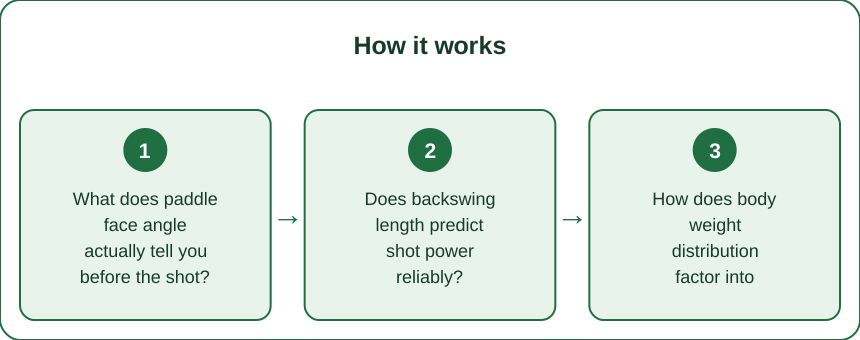
What does paddle face angle actually tell you before the shot?
An open paddle face (tilted back) typically signals a lofted shot — a dink, drop, or lob — while a closed or vertical face signals a flatter, more aggressive drive. Watching the face angle during the backswing, rather than waiting for contact, gives you the earliest reliable read on shot trajectory.
Does backswing length predict shot power reliably?
Generally, yes — a short, compact backswing is common for controlled dinks and resets, while a longer backswing with more shoulder rotation typically precedes a drive or a more aggressive shot, making backswing length one of the more consistent visual cues available before contact.
How does body weight distribution factor into anticipating a shot?
Weight shifting forward and low often precedes a drop shot or dink, since these shots benefit from a controlled, grounded stance, while weight shifting backward or rotating through the hips more typically precedes a drive, where generating power requires more body rotation.
Can paddle grip pressure or hand position be read from a distance?
At closer range, yes — a firmer, higher grip on the handle often correlates with a more aggressive, power-oriented swing, while a relaxed, lower grip is more common for touch shots, though this cue is more reliable at the net than from the baseline given viewing distance.
Does court positioning itself provide anticipation clues before the swing even starts?
Yes — a player who has drifted slightly off-balance or is stretched wide to reach a ball has fewer viable shot options available, narrowing the realistic range of shots you need to anticipate, compared to a player in a balanced, centered position with the full shot menu available.
Can this skill actually be trained deliberately, and how?
Yes, significantly — watching video of regular opponents or practice partners, focused specifically on their pre-shot cues rather than the outcome, accelerates pattern recognition faster than passive match experience alone. On-court, consciously calling out your shot prediction just before contact, then checking it against what actually happens, builds the same recognition through deliberate practice rather than simply playing more points.
FAQ: Reading Opponent Shots in Pickleball Questions, Answered
Does this anticipation skill matter more at the net or from the baseline?
It matters significantly in both areas, though the visual cues (grip, weight shift) are easier to read at closer net range than from a full baseline distance.
Can deceptive players intentionally disguise these cues?
Yes, advanced players sometimes deliberately disguise paddle angle or backswing to create false reads — recognizing genuinely deceptive players and adjusting trust in the cues accordingly is itself part of the skill.
How long does it typically take to notice real improvement in shot anticipation?
Many players report a noticeable improvement within a few weeks of deliberate, focused practice on pre-shot cues, since it’s primarily a pattern-recognition skill that responds well to consistent attention.
TL;DR:
- Paddle face angle during the backswing is one of the earliest reliable cues to shot trajectory
- Backswing length and body weight shift both help distinguish power shots from touch shots
- A stretched or off-balance opponent has fewer realistic shot options to anticipate
- Deliberate practice — predicting shots before contact and checking accuracy — builds this skill faster than passive play
In your next practice session, try calling your shot prediction out loud before contact — it turns a passive skill into something you can actively train.
See It in Motion
Seen here: UPF 50+ Adjustable A-Line Running Skort with Pockets — shop it on bubblelime.com
Keep Reading
This article is for general informational and styling purposes only. Fit, sizing, and product availability may vary.