The Complete Guide to Surviving the Pickleball Transition Zone
Quick Answer: The transition zone is the roughly seven feet between the baseline and the non-volley line where you are too close to let balls bounce and too far to volley aggressively. Cross it in stages, not in one sprint: hit, split step, read, advance. The three skills that make it survivable are the split step, the soft block volley off the bounce, and knowing when to stop and hold rather than continue forward.
You hit a decent third shot drop, ran for the kitchen, and got the next ball driven at your feet. That is not a technique failure. That is a movement pattern failure, and it is the single most common thing separating 3.0 from 4.0.

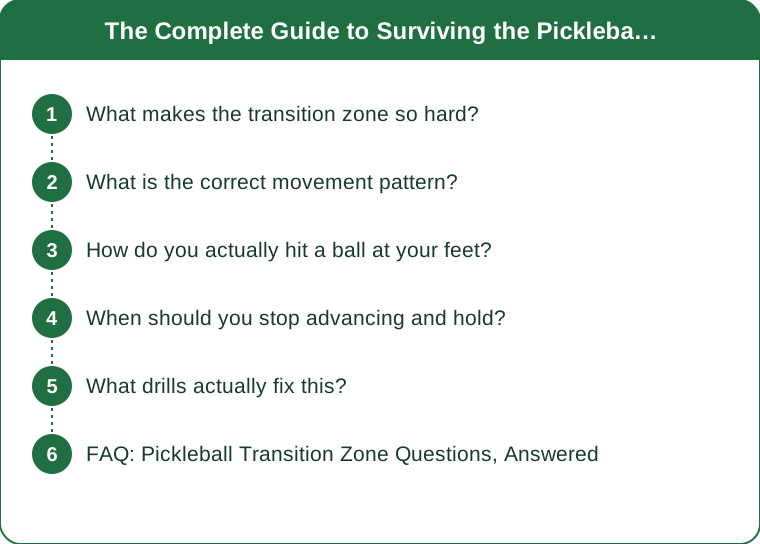
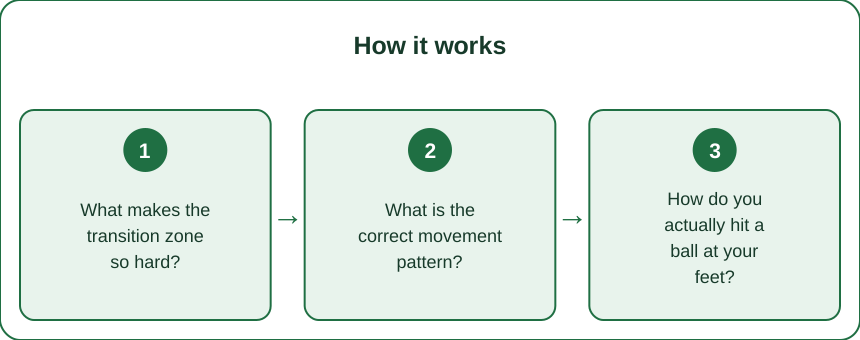
What makes the transition zone so hard?
Geometry, and the fact that it puts you in the worst possible relationship with a bouncing ball.
At the baseline, you have time. A ball bounces, rises, and you hit it at a comfortable height with a full swing. At the kitchen line, you have no time but you also do not need it, because you are volleying out of the air before the ball can drop.
In the transition zone you get the worst of both. Balls arrive after the bounce but at or below knee height, because they have already begun descending by the time they reach you. Hitting up from below the net is a losing proposition, and hitting hard from below the net is how you feed your opponents a put-away.
The zone is also the place where your feet are most likely to be moving when the ball arrives, and hitting while moving forward through a low ball is one of the harder skills in the sport.
Add the psychology. You have just executed a shot you were proud of and your instinct is to reward it by charging. That instinct is precisely what puts you flat-footed mid-court at contact.
The better mental model is that the transition zone is not a place you run through. It is a place you occupy briefly, deliberately, and with a plan for the next ball.
What is the correct movement pattern?
Four beats, repeated: hit, split step, read, advance.
After you hit your third shot, take two or three steps forward and then stop with a split step before your opponent makes contact. A split step is a small hop that lands you balanced with weight on the balls of your feet, and its job is to convert forward momentum into readiness in either direction.
The timing is the whole thing. Your split step should land as your opponent strikes the ball, not before and not after. Landing early means you are stationary too long and lose ground. Landing late means you are airborne or off-balance at contact.
Read the ball. If it is high or soft, advance and take it out of the air. If it is at your feet, stay where you are, hit a controlled shot, and split step again.
Then advance, but only as far as the next split step allows. Most players need two to three cycles to travel from baseline to kitchen against a competent opponent, and that is correct rather than slow.
The error almost everyone makes is treating the trip as one continuous run. You are not trying to get to the kitchen fast. You are trying to get there balanced. A player who arrives at the kitchen line off-balance is worse off than a player who is still four feet back and set.
One more detail: your first two steps should be shorter than feels natural. Long strides commit your weight forward, and forward weight is exactly what makes a low ball at your feet unplayable.
How do you actually hit a ball at your feet?
Soften everything and aim for the opponent’s feet, not for a winner.
The technical version: paddle face slightly open, contact out in front, wrist quiet, and absorb rather than swing. Think of catching the ball on the paddle face and redirecting it rather than striking it. Some coaches teach it as a block with a small lift.
Grip pressure is the variable that changes this shot most. A tight grip transmits the ball’s pace back into a fast, high reply. A relaxed grip, maybe a four out of ten, lets the paddle absorb energy and drops the ball short.
Bend at the knees, not at the waist. Bending at the waist drops your head and paddle together and makes the contact point unpredictable. Knee bend keeps your eyes level and your paddle stable.
Target selection matters as much as technique here. The correct target from the transition zone is almost always low and to the opponent’s feet at the kitchen line, or a soft ball into the kitchen itself. Not the sideline, not a passing shot, not a hard drive.
Why: from below net height, an aggressive shot has to travel upward to clear the net and will arrive at your opponent above net height, which is a gift. A soft ball forces them to hit up too, which neutralizes their position advantage and lets you finish your approach.
The rule that simplifies it: if you are below the net, your job is to make them hit up. Nothing else.

When should you stop advancing and hold?
This is the decision that most separates intermediate from advanced play, and the answer is more often than players think.
Hold your ground when: your shot was high or landed short, the opponent is preparing to drive, you are off-balance, or your partner is significantly behind you.
That last one gets ignored. Pickleball doubles is played as a two-person line, and a split team offers a diagonal seam that experienced opponents will attack every single time. If your partner is stuck at the baseline, you are better off holding at mid-court with them than being alone at the kitchen. The line matters more than the position.
When holding, get low and get your paddle up in front of your chest. A defensive position in the transition zone is a compressed one: knees bent, paddle high and forward, weight forward on the balls of the feet.
The most common tell that you should have held: you get passed or handcuffed on the very next ball. If that keeps happening, you are advancing off shots that did not earn an advance.
And there is a legitimate strategy of not advancing at all in some situations. Against opponents who consistently drive well, playing a couple of points from further back and using deep resets can be smarter than repeatedly getting caught in the zone. It is not the standard advice and it wins matches.
What drills actually fix this?
Three, in order, and all of them can be done with one partner.
Drill 1: the four-cone advance. Place markers at the baseline, two feet in, four feet in, and at the kitchen. Your partner feeds a ball each time you split step at a marker. Your only job is to reset it softly and advance one marker. Miss the reset and you go back one. This builds the stop-hit-advance rhythm faster than anything else.
Drill 2: feet-only feeds. Partner stands at the kitchen and deliberately feeds balls at your feet while you stand in the transition zone. Twenty in a row. You are not trying to win the point, only to make every ball land soft in the kitchen. Track your success rate; going from 6/20 to 15/20 is a full skill level in that specific situation.
Drill 3: split step timing with a call. Partner calls out loud at the instant of contact. You try to have your split step land on the call. This sounds trivial and it corrects the timing error that undermines the entire pattern.
Spend fifteen minutes a session on these rather than sixty minutes of games. The transition zone is a trainable skill and games do not train it, because in a game you get maybe eight repetitions in an hour and no feedback on any of them.
A final note on paddle readiness: keep the paddle up between shots in the zone. Reaction time at mid-court is short enough that a paddle at hip height is already too late for a driven ball at your chest. Paddle up, in front, always.
FAQ: Pickleball Transition Zone Questions, Answered
Should I ever run straight through to the kitchen?
Yes, when your shot was genuinely excellent, meaning it landed short in the kitchen and forced your opponent to hit up. In that case the risk of a driven ball is low and the position gain is worth it. That is maybe one third of third shots for most players.
Why do I keep hitting the ball into the net from mid-court?
Usually because the paddle face is too closed and the swing is too long. Open the face slightly, shorten the motion to almost nothing, and let the ball’s own pace do the work. If you are also bending at the waist, fix that first.
Is the transition zone the same as no man’s land in tennis?
Similar idea, different consequences. In tennis you are told never to stand there. In pickleball you cannot avoid it, because getting to the kitchen line is the whole strategy. Pickleball requires you to occupy it competently rather than avoid it.
TL;DR:
- The transition zone forces you to hit low balls from below net height, which is a losing position
- Cross in stages: hit, split step timed to their contact, read the ball, advance
- With a relaxed grip and an absorbing block, target their feet and make them hit up
- Hold your ground when your shot was weak or your partner is behind; the team line matters more than your position
Stop trying to get to the kitchen faster. Start trying to get there balanced, and the driven ball at your feet mostly disappears.
See It in Motion
Seen here: UPF 50+ Adjustable A-Line Running Skort with Pockets — shop it on bubblelime.com
Keep Reading
This article is for general informational and styling purposes only. Fit, sizing, and product availability may vary.