Complete Guide: Why the Court Surface Changes Your Game More Than Your Paddle Does
Quick Answer: Court surface changes bounce height, ball speed off the bounce, available friction for footwork and how quickly your legs fatigue — all four of which affect more shots per game than paddle choice does. A ball bounces higher and faster off smooth concrete than off a cushioned sport tile, and grip differences between indoor wood and outdoor acrylic change how far you can safely reach. Adjusting contact point, split-step timing and shot selection to the surface is worth more than any equipment purchase.
You play well at your home courts. You go somewhere else and your dinks pop up, your drops land long, and your legs are gone by game three.
Same paddle. Same ball. Same you.
The surface is a bigger variable than almost anyone accounts for.
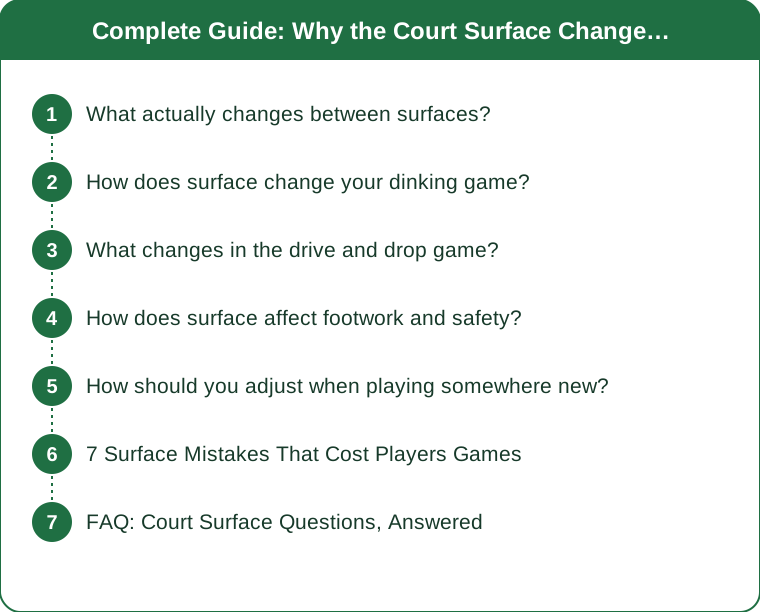
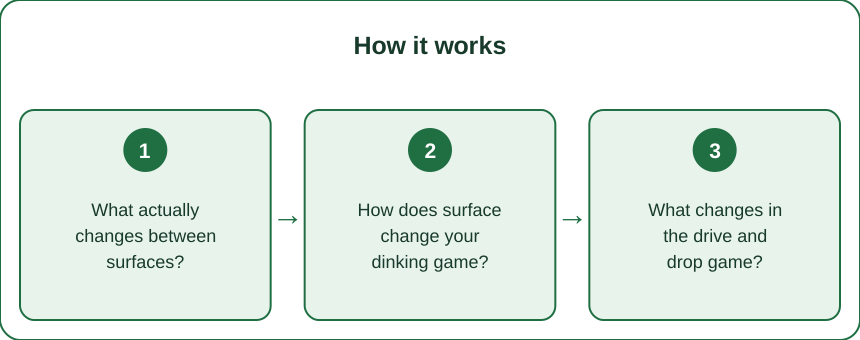
What actually changes between surfaces?
Four properties, each of which affects a different part of your game.
Bounce height. Harder surfaces return more energy to the ball, so the bounce is higher and arrives sooner. Cushioned acrylic and sport tile absorb more, producing a lower, slower bounce. The difference is enough to change whether a dink sits up in your strike zone or below it.
Ball speed after the bounce. Smoother, harder surfaces preserve more horizontal speed. Textured or cushioned surfaces scrub it off. This is why the same drive feels attackable on one court and unreachable on another.
Friction available to your shoes. Indoor wood and sport tile provide high grip; dusty outdoor acrylic provides much less. Grip determines how aggressively you can change direction and how far you can safely stretch.
Energy return to your legs. Concrete returns impact energy to your joints; cushioned systems absorb it. Over a three-hour session this is the difference between fresh legs and a sore back.
Temperature interacts with all of it. Outdoor surfaces heat substantially in sun, and a hot ball is livelier than a cold one. The same court plays differently at 9am and 2pm.
And the ball itself is surface-sensitive. Outdoor balls are harder with smaller holes; indoor balls are softer with larger ones. Playing an indoor ball on a rough outdoor surface produces a dead, unpredictable game that people usually blame on themselves.
How does surface change your dinking game?
The soft game is where surface differences are most consequential, because margins are smallest.
Higher bounce means more pop-ups. On a hard, fast surface the ball reaches your paddle higher and with more speed, so the same paddle angle that produced a perfect dink at home now sends the ball up.
Adjust your contact point, not your swing. On a livelier surface, take the ball earlier and lower, closer to the bounce, before it reaches its apex. This is the single most useful surface adjustment in the soft game.
Paddle face angle needs to close slightly. More incoming energy needs more downward face to keep the ball low. It is a small change and it takes about ten minutes of warm-up to find.
Slower surfaces reward patience. On a cushioned surface the ball dies faster, so aggressive dinks that would be attacked elsewhere become viable, and long dink rallies become genuinely long.
Footwork spacing changes. A faster bounce means less time, which means smaller adjustment steps and an earlier split-step. Trying to use your home-court footwork rhythm on a faster surface is why players feel rushed.
Warm up the soft game specifically. Most players warm up drives and serves. Ten minutes of dinking on an unfamiliar surface tells you more about how the day will go than any other warm-up.
Practical rule: if your dinks are popping up on a new court, take the ball earlier before you change anything else.
What changes in the drive and drop game?
The third shot drop is the most surface-sensitive shot in pickleball.
Drops land long on fast surfaces. More energy preserved through the bounce means a drop that landed in the kitchen at home now bounces to your opponent’s strike zone. This is the most common cause of a drop game falling apart on unfamiliar courts.
Aim shorter, not softer. The instinct is to hit the drop softer, which usually produces a net error. Aiming for a shorter landing point while keeping the same swing is more reliable.
Drives are more effective on fast surfaces. The ball skids and stays low, which is exactly what makes a drive hard to handle. On a fast court, drive-and-crash strategies gain value.
Drives lose value on slow surfaces. The ball sits up and slows, giving opponents time. On cushioned courts, the drop-and-approach game is stronger.
Serve depth changes too. A serve that lands three feet inside the baseline pushes an opponent back on a fast surface and lands harmlessly on a slow one.
Spin behaves differently. Rougher surfaces grip the ball more at bounce, exaggerating spin effects. Smooth surfaces preserve trajectory more predictably.
Two-minute test. Before a game on a new court, hit five drops from the baseline and watch where they land relative to where you aimed. The correction you need is usually obvious and consistent.
How does surface affect footwork and safety?
This is where surface stops being a tactics question and becomes an injury one.
Grip determines safe reach. On high-grip indoor surfaces, your shoe stops when you plant, so a lunge is controlled. On dusty outdoor acrylic, a plant can slide, which is a common mechanism for ankle and knee incidents.
Court shoes are surface-specific for a reason. Indoor court shoes use gum rubber optimised for grip on smooth surfaces; outdoor shoes use harder compounds that resist abrasion. Wearing indoor shoes outdoors wears them out fast; wearing outdoor shoes indoors provides less grip than you expect.
Running shoes are the actual hazard. They are built for forward motion with elevated, cushioned heels that reduce lateral stability. Lateral movement is most of pickleball, and this mismatch is a leading contributor to court injuries.
Dust is an invisible variable. Outdoor courts collect fine grit that dramatically reduces grip. A quick sweep of your service area before play is not fussiness, it is a genuine safety step.
Damp surfaces are the highest risk. Morning dew on outdoor acrylic produces a surface that looks fine and is not. If a court looks damp, test it with a deliberate slide before you rely on it.
Cushioned surfaces reduce fatigue meaningfully. Players consistently report less lower-body fatigue on cushioned systems, which shows up in the third game rather than the first.
Autumn note: falling leaves, low sun and morning damp arrive together. Leaves on an outdoor court are as slippery as ice underfoot, and low autumn sun changes where you can safely look. Both are worth a walk of the court before the first serve.
How should you adjust when playing somewhere new?
A repeatable ten-minute routine removes most of the disadvantage.
Walk the court first. Check for damp patches, dust, cracks and debris. Thirty seconds, and it is the highest-value part of this list.
Bounce the ball hard once and watch it. A single hard bounce tells you most of what you need about surface speed before you hit anything.
Warm up dinks before drives. The soft game reveals surface behaviour with more precision than power shots do.
Hit five drops and note the error direction. Consistently long means a fast surface; consistently short means a slow one. Adjust your target, not your technique.
Test your footing deliberately. A controlled lateral slide in a safe moment tells you how far you can reach today.
Adjust strategy, not identity. On fast surfaces, drive more and take the ball earlier. On slow surfaces, be patient and use the drop game. Playing your preferred style regardless of surface is what produces frustrating away games.
Check the sun and wind before choosing ends. Outdoors this frequently matters more than any surface variable, particularly in autumn when the sun sits low for much of the playing day.
7 Surface Mistakes That Cost Players Games
Blaming the paddle. The most common misattribution in the sport. If your game changed and your paddle did not, look at the court.
Warming up only power shots. Drives tell you least about surface. Dinks tell you most.
Wearing running shoes. Elevated cushioned heels plus lateral movement is the wrong combination on any surface, and worse on high-grip ones.
Hitting drops softer when they land long. This produces net errors. Aim shorter instead.
Ignoring dust and leaves. Both reduce grip dramatically and both are removable in under a minute.
Playing the same style everywhere. Fast surfaces reward drives; slow surfaces reward the drop game. Refusing to adapt is a choice to play worse.
And the one nobody plans for: fatigue. Hard, uncushioned surfaces cost noticeably more in the third game. If you are playing a long session on concrete, pace the first two games differently than you would on a cushioned court.
FAQ: Court Surface Questions, Answered
Which surface is fastest?
Smooth, hard concrete or asphalt with a thin acrylic coating. Cushioned acrylic systems and sport tile play slower.
Do I need different shoes for indoor and outdoor?
Ideally yes. Outdoor compounds resist abrasion; indoor gum rubber grips smooth surfaces. Using one for the other costs either grip or shoe life.
Why do my drops land long on unfamiliar courts?
More energy preserved through the bounce. Aim for a shorter landing point rather than swinging softer.
Does temperature really change the ball?
Yes. Warmer balls are livelier and harder ones crack more readily in cold. Outdoor play in the same day can span a real range.
Is a cushioned court worth seeking out?
For long sessions and for anyone managing joint issues, clearly yes. The difference shows up in the third game.
How long does it take to adapt to a new surface?
With a deliberate ten-minute warm-up focused on dinks and drops, most players adapt within a game. Without it, some never do.
TL;DR:
- Surface changes bounce height, post-bounce speed, footing grip and leg fatigue — all four affect more shots than paddle choice.
- Fast surfaces make dinks pop up and drops land long; take the ball earlier and aim shorter.
- Fast courts reward drives; slow, cushioned courts reward the drop game and patience.
- Court-specific shoes matter; running shoes are a genuine injury risk in lateral sport.
- Walk the court, bounce a ball hard, warm up dinks before drives, and clear dust and leaves.
Next time your game falls apart on an away court, check the surface before you check your paddle.
See It in Motion
Seen here: UPF 50+ Pleated Running Skort with 26” Leggings & Pockets — shop similar styles on bubblelime.com
Keep Reading
This article is for general informational and styling purposes only. Fit, sizing, and product availability may vary.