The Complete Guide to Why Running Shoes Cause Pickleball Injuries
Quick Answer: Running shoes are designed for repeated forward motion, with a high cushioned stack, a soft heel, a narrow outsole, and an upper with minimal lateral support. Pickleball is played almost entirely with lateral movement, split steps, and sudden stops. In a running shoe, that combination raises your foot above a narrow unstable base and lets it slide off the footbed during side-to-side movement, which is a direct route to rolled ankles. Court shoes have a wider flatter base, reinforced lateral uppers, and a herringbone outsole. Switching is the cheapest injury-prevention decision in the sport.
Most people arrive at pickleball from somewhere else, wearing the trainers they already own.
The paddle gets researched for weeks, and the shoes are whatever was in the cupboard. It is the reverse of the correct priority order, and it accounts for a large share of the injuries that keep people off the court.
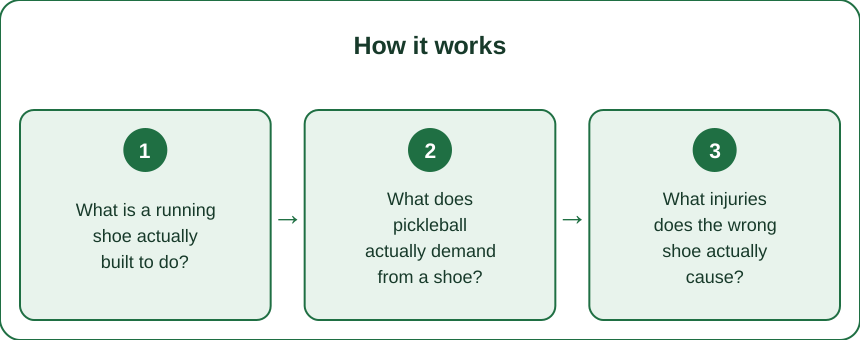
What is a running shoe actually built to do?
Absorb repeated impact in one direction, efficiently, for a long time.
Running is close to a one-dimensional activity. The foot strikes, rolls forward, and pushes off, thousands of times, with forces travelling mostly along the length of the foot. A running shoe is optimised for that specific pattern.
High stack height is the defining feature of modern running shoes. Thick cushioning between foot and ground reduces impact stress over long distances. It also raises your centre of gravity, which is irrelevant when moving forward and significant when moving sideways.
The heel is deliberately soft and often flared. Designed to accept a heel strike and compress. That compression is exactly the thing you do not want under a sudden lateral push, because the shoe collapses to one side under you.
The outsole is narrow relative to the foot. Running shoes taper, particularly in the midfoot, because a narrow waist saves weight and is fine when the load runs front to back.
The upper is light and unstructured. Modern running uppers are engineered mesh chosen for breathability and weight, with minimal reinforcement at the sides because running does not push the foot sideways.
Every one of those choices is correct for running and wrong for a court. This is not a case of a lesser shoe. It is a shoe optimised for a different problem.
What does pickleball actually demand from a shoe?
Almost the opposite list.
Lateral movement dominates. Court coverage in pickleball is mostly side to side and diagonal, with short forward and backward adjustments. The forces run across the foot rather than along it.
Sudden stops and direction changes. The split step, the lunge to a wide dink, the recovery back to the kitchen line. Each of these applies a large sideways force at the moment your foot is planted.
A low, stable base is what handles that. A wide flat outsole gives the foot a platform that does not tip. This is why court shoes look chunky and sit low, and it is a functional design rather than an aesthetic one.
Lateral containment in the upper. Court shoes use reinforced overlays or a firmer material along the sides to stop the foot sliding off the footbed during a hard cut. This is the feature people notice most immediately when they switch.
A herringbone or modified herringbone outsole. The pattern grips in every direction and releases predictably, which is what allows a controlled slide and stop rather than either sticking abruptly or sliding uncontrollably.
Durability at the toe and the medial forefoot. Lunging drags the toe. Court shoes reinforce it. Running shoes wear through it in weeks.
Different soles for different surfaces. Outdoor court shoes have a more durable rubber compound for abrasive concrete and asphalt. Indoor court shoes use a softer non-marking gum rubber for grip on wood or sport tile. Playing outdoors in indoor shoes wears them out fast.
And modest cushioning is the goal, not maximum. Enough to protect the joints, not so much that stability is compromised. This is the trade-off that maximally cushioned running shoes sit on the wrong side of.
What injuries does the wrong shoe actually cause?
The pattern is consistent enough that court-side coaches can often guess the shoes.
Ankle sprains. The headline risk. A high-stack shoe raises the ankle above a narrow base, which increases the leverage available to roll it. Add a soft compressible heel and a lunge to the side, and the shoe rolls before you do. Ankle injuries are among the most common in pickleball, and shoes are one of the few modifiable factors.
Foot sliding inside the shoe. With an unstructured upper, the foot slides laterally on the footbed during a cut. This produces blisters on the sides of the foot, black toenails, and a general lack of confidence in fast movements. Many players unconsciously slow down to compensate, which limits their game.
Knee stress. When the shoe moves under the foot, the knee absorbs the correction. Repeated small corrections are a plausible contributor to the knee complaints that show up in players who move well otherwise.
Achilles and calf strain. The drop and heel geometry of running shoes differ from court shoes, and sudden explosive lateral pushes from a soft heel load the calf and Achilles differently than they would from a firm stable platform.
Slips on the return. A running outsole is optimised for forward traction on varied terrain. On a smooth court surface, particularly a slightly dusty outdoor one, it does not release and grip predictably in a sideways slide, which produces both slips and abrupt catches.
A note on what shoes will not fix. Pickleball elbow, which this blog has covered in detail, is not a footwear problem. Neither is most of the shoulder discomfort players report. Shoes address the lower-body injury pattern specifically, and that pattern is a large share of the time players lose to injury.
How do you choose a court shoe?
Four decisions, and the first two matter most.
1. Indoor or outdoor, matched to where you play.
- Outdoor for concrete and asphalt courts. Durable rubber, deeper tread, usually with an outsole durability warranty from major brands.
- Indoor for wood or sport court surfaces. Gum rubber, non-marking, softer and grippier.
- If you play both, buy for whichever you play more, and accept faster wear if you use outdoor shoes indoors. Do not use indoor shoes outdoors, since they will not last.
2. Tennis shoes are the right category if pickleball-specific options are limited. Tennis shoes are built for exactly the same movement pattern and are widely available. Pickleball-specific shoes are typically tennis shoes with slightly lighter construction and sometimes a wider toe box. Either works. Volleyball and squash shoes are also reasonable for indoor play.
3. Fit for lateral movement, not just length. Try shoes on late in the day, in the socks you play in, and specifically do a few side steps and a lunge in the shop. You are checking that your foot does not slide toward the little toe under a lateral push. Length should leave a thumb’s width at the toe, since lunging pushes the foot forward.
4. Replace on court time, not on appearance. Court shoes lose their lateral support and outsole grip before they look worn. A player on court three times a week should expect to replace them a few times a year. A shoe with a smooth outsole in the forefoot has lost the grip pattern regardless of how much tread is left elsewhere.
What about people with existing foot problems? Court shoes are generally firmer and less accommodating than running shoes, so anyone managing plantar fasciitis or an existing foot condition should consider a supportive insole in a court shoe rather than reverting to running shoes. A podiatrist is the right person for that conversation. This is general information, not medical advice.
What else in your setup matters for injury?
A short list, because the shoe is the main one and not the only one.
Socks. Cushioned court socks reduce blistering and take up volume, which improves fit. A thin cotton sock in a court shoe is a blister generator. Cotton in particular holds moisture and increases friction.
Warm-up. Pickleball starts fast, with a split step and a lunge within the first minute of a casual game. Five minutes of movement preparation, including lateral shuffles and gentle lunges, addresses the cold-start problem that produces a substantial share of early-game strains.
Court surface awareness. Outdoor courts collect dust, leaves, and moisture, all of which change grip unpredictably. A quick sweep of the playing area before a session is not fussy, it is the cheapest slip prevention there is, and it matters more as autumn brings leaf fall onto outdoor courts.
Paddle weight, for a different injury pattern. This blog has covered how paddle weight affects wrist fatigue, and it belongs in the injury conversation even though it is unrelated to footwear.
Playing volume. The most common injury pattern in pickleball is not a dramatic incident but a gradual overuse problem in players who go from nothing to five sessions a week because they enjoy it. Build up over weeks the way you would with any new sport.
Eyewear on outdoor courts. Low autumn sun and a fast ball at close range is a genuine hazard, and this blog has covered playing in fall wind and low sun separately. Eye protection is normal in comparable sports and is under-adopted here.
Myth vs Fact: Pickleball Shoes
Myth: Pickleball is low impact, so any shoe is fine. Fact: The impact forces are moderate and the lateral forces are high. Injury risk in pickleball comes from direction changes and sudden stops, which is precisely what running shoes are not built to handle.
Myth: More cushioning means fewer injuries. Fact: For court sports, past a moderate amount, more cushioning means less stability and a higher centre of gravity. The injury pattern in pickleball is instability rather than impact, so extra cushioning works against you.
Myth: You need pickleball-specific shoes. Fact: Tennis shoes are built for the same movement pattern and are usually more widely available in more sizes and widths. Pickleball-specific models are a fine option, and they are not a requirement.
Myth: Cross-trainers are a good compromise. Fact: Better than running shoes and worse than court shoes. Cross-trainers have a flatter, more stable base but generally lack the reinforced lateral upper and the herringbone outsole. Acceptable for casual play, not for competitive.
Myth: You will feel the difference immediately. Fact: Many players find court shoes feel firm and less comfortable for the first two or three sessions, because they are used to running shoe cushioning. The confidence in lateral movement usually shows up before the comfort does.
Myth: Replace them when the tread wears out. Fact: The lateral support in the upper degrades before the outsole does in many cases. If your foot has started sliding inside the shoe on hard cuts, the shoe is finished regardless of how the sole looks.
Seasonal note: outdoor court conditions change substantially in autumn, with damp mornings, leaf debris, and lower sun. A fresh outsole matters more in October than in July, and it is a good time to check whether the forefoot pattern on your shoes has gone smooth.
FAQ: Pickleball Shoes and Injuries, Answered
Can I play pickleball in running shoes?
You can, and it is the most common gear mistake in the sport. Running shoes have a high narrow base, a soft compressible heel, and no lateral reinforcement, which is a direct contributor to rolled ankles during side-to-side movement.
Are tennis shoes okay for pickleball?
Yes. Tennis shoes are built for the same lateral movement pattern and are often more widely available in more widths. Pickleball-specific shoes are essentially the same category with minor adjustments.
What is the difference between indoor and outdoor court shoes?
Outsole compound and tread. Outdoor shoes use harder, more durable rubber for abrasive concrete. Indoor shoes use softer non-marking gum rubber for grip on wood or sport tile. Indoor shoes wear out quickly if used outdoors.
How often should I replace court shoes?
Based on court hours rather than appearance. Playing three times a week, expect a few pairs a year. Replace as soon as your foot starts sliding inside the shoe on a hard cut, even if the tread looks fine.
TL;DR:
- Running shoes are built for forward motion: high stack, soft heel, narrow base, unstructured upper. Every one of those is wrong for a court.
- Pickleball is lateral, with sudden stops. It needs a low wide base, reinforced sides, and a herringbone outsole.
- The injury pattern is instability rather than impact, which is why more cushioning makes it worse rather than better.
- Tennis shoes work fine. Match indoor or outdoor to where you play, and replace when your foot starts sliding, not when the tread looks worn.
If you have spent more time researching paddles than shoes, you have the priority order backwards.
See It in Motion
Seen here: UPF 50+ Pleated Running Skort with 26” Leggings & Pockets — shop similar styles on bubblelime.com
Keep Reading
This article is for general informational and styling purposes only. Fit, sizing, and product availability may vary.