Complete Guide: Why You Lose Points on the Return of Serve - and How to Fix Each One
Quick Answer: The return of serve has one primary job: hit it deep enough that you have time to walk to the kitchen line before the third shot arrives. Winning the return is not about power or placement cleverness - it is about depth plus forward movement. The five failures that cost most points: returning too short, returning and standing still, taking the ball on the rise, hitting with too much pace, and starting from the wrong position. All five are fixable without changing your stroke mechanics.
The returning team has a structural advantage in pickleball, and a weak return is what gives it away.
This guide covers each failure in order, with the drill that fixes it.
Why the return matters more than the serve
This is the strategic foundation that makes everything else make sense.
Pickleball’s two-bounce rule means the serving team must let the return bounce before hitting the third shot. That single rule creates a structural advantage for the returning team, and it is larger than most recreational players realize.
Here is why. After you return, you have the entire flight of the ball plus the bounce on the other side to move forward. The serving team, meanwhile, is stuck behind their own baseline waiting for the ball to bounce. By the time they hit the third shot, you and your partner should both be at the kitchen line and they should still be in the back court.
Whoever gets to the kitchen line first wins most rallies at every level. From the kitchen, you hit down; from the baseline, you hit up. A team at the kitchen against a team at the baseline wins that exchange the large majority of the time.
So the return’s purpose is not to be a weapon. It is to buy you the distance from baseline to kitchen - roughly 15 feet - before the third shot arrives.
Which reframes everything. A soft, deep, high return that lands two feet from the baseline is a great return, because it gives you maximum time. A hard, low, fast return that lands mid-court is a poor one, because it arrives quickly at the opponent’s feet in a position from which they can attack while you are still in no-man’s land.
Recreational players consistently get this backwards, treating the return as an offensive opportunity. The return is a positioning shot. Once you accept that, the specific fixes below become obvious rather than arbitrary.
Failure 1: The return lands too short
The single most costly error, and the most common.
A short return - anything landing in the middle third of the court - hands the serving team the initiative. They step in, take the ball comfortably, and either drive it at your feet or drop it into the kitchen while you are still moving forward.
Your target is the last three feet before the baseline. Deep enough that they must hit from behind the line, which is the hardest place to hit a good third shot from.
Why returns land short:
Hitting too flat. A flat return has to clear the net with very little margin, so players instinctively hit softer to keep it in, and soft plus flat equals short. Add height, not force. A return that crosses four to six feet above the net can be hit with the same effort and land four feet deeper.
Taking the ball too early. Rushing the contact reduces the swing length and shortens the shot.
Standing too close to the baseline. If you are crowded, you have no room to swing forward through the ball.
The fix - the deep return drill: place a towel or a line of cones three feet inside the opponent’s baseline. Return 20 serves aiming to land past the towel. Count how many make it. Most recreational players start below 8 out of 20 and reach 15 within a few sessions - and their win rate moves with it, because this single number is that important.
And when in doubt, aim higher rather than harder. Height buys depth at no cost in control.
Failure 2: Returning and standing still
The second-biggest point leak, and the easiest to fix because it requires no skill at all.
The return is not finished when you hit it. It is finished when you reach the kitchen line. Players who hit a beautiful deep return and then admire it from the baseline have wasted the advantage they just created.
The movement should begin as part of the stroke. Step into the ball, hit through it, and let that momentum carry you forward. You should be moving toward the net before the ball has crossed it.
How far should you get? All the way to the kitchen line, ideally. On a good deep return you have time - roughly two seconds - which is enough to cover the distance at a brisk walk.
The intermediate case: if the return was shorter than intended, get as far as you can and then split-step. Being caught moving is worse than being caught in a slightly poor position - a split step at the moment they contact the ball lets you react in either direction.
Never stop in the transition zone by choice. The area between the baseline and the kitchen is where balls land at your feet and you have to hit up. Pass through it, do not park in it.
The fix - the return-and-run drill: have someone serve 20 balls. Return each one and continue to the kitchen line, touching it with your foot before stopping. Do not evaluate the return; evaluate whether you touched the line. This drill retrains the habit in one session because it removes the judgment about whether the return was good enough to advance behind.

Failure 3: Taking the ball on the rise, and Failure 4: Too much pace
Failure 3: Taking the ball on the rise
Letting the ball drop is almost always better on a return. A ball taken on the rise, shortly after the bounce, is moving upward and away, which makes depth control genuinely difficult.
Let it come up and start to descend, then hit it. At the top of the bounce or just after, the ball is briefly moving slowly, and a slower ball is dramatically easier to place deep.
This feels wrong to players from a tennis background, where taking the ball early buys time and pressure. In pickleball, with a plastic ball and a small court, the time you gain by hitting early is worth less than the depth you lose.
The practical version: start deeper. Stand two to three feet behind the baseline to receive. That extra space gives you room to let the ball drop without being crowded, and you make up the distance while moving forward.
Failure 4: Hitting the return too hard
Pace on the return works against you twice. It reduces your own time to advance, and it gives the opponent’s third shot free energy to work with.
A slower, deeper, higher return is strictly better in most situations. It maximizes your walking time and forces them to generate their own pace from a difficult position.
The one exception: a hard, low return directly at the feet of an opponent who has already crept forward. Against a player standing at mid-court, a driven return is genuinely effective - but it is a specific response to a specific error, not a default.
The fix: hit 20 returns at roughly 60 percent effort with extra height and see how many land deep. Most players are surprised that depth improves as effort decreases.
Failure 5: Starting from the wrong position
Where you stand before the serve determines what returns are even available to you.
Stand two to three feet behind the baseline, not on it. This is the most common positional error at recreational level.
Why deeper is better:
You can move forward into the ball, which adds depth naturally and starts your momentum toward the kitchen. A player standing on the baseline has to move backward for any deep serve, and backward movement is slow, unbalanced, and produces short returns.
You have room to let the ball drop, which is failure number three solved by position rather than by timing.
Deep serves stop being a problem. The serve that would have jammed you now bounces comfortably in front of you.
Position laterally based on the serve angle. Split the difference: stand roughly in line with where the widest and narrowest serves would go, adjusted for your own strengths. If your backhand is weaker, shade slightly to protect it - this is standard and not a weakness to hide.
Your partner’s position matters too. The non-receiving partner should already be at the kitchen line before the serve. They have no reason to be anywhere else - the two-bounce rule means they cannot be hit until after the return bounces. A partner standing back with you gives away the entire structural advantage, and it is startlingly common in recreational play.
The fix: before each serve, check two things - your own feet are behind the baseline, and your partner is at the kitchen. Two seconds of checking prevents most of the positional problems in the whole game.
Putting it together, plus fall outdoor conditions
The complete return sequence, in order:
- Set up two to three feet behind the baseline, partner already at the kitchen.
- Split-step as the server contacts the ball.
- Let the ball bounce and begin to drop.
- Step forward into the shot, hitting with height and moderate pace.
- Target the last three feet of the court.
- Keep walking to the kitchen line without evaluating the return.
- Split-step as they contact the third shot.
Practice it as a sequence, not as a stroke. The whole thing is one motion from setup to kitchen line, and drilling the pieces separately produces players who hit good returns and stand still.
Fall outdoor conditions change several inputs.
Wind is the big one. A headwind shortens every return, so aim higher and deeper than feels correct. A tailwind does the opposite and will send your normal return long - flatten it and take pace off. Check the wind on the changeover, every time.
Low autumn sun sits directly in the returner’s eyes on east-west courts in the morning and late afternoon. A visor or a hat with a brim is genuinely worth more than most equipment upgrades in this season.
Cold balls behave differently. Below roughly 60°F, plastic balls become harder and less lively, and they crack more easily. Returns need slightly more effort for the same depth, and it is worth having a fresh ball on cold mornings.
And cold muscles need a longer warm-up. Pickleball’s most common injuries involve sudden lateral movement and the Achilles. Five extra minutes of dynamic warm-up in October is cheap insurance.
FAQ: Return of Serve Questions, Answered
Should I return to the weaker player or to the same player every time?
Generally return deep to whoever is weaker at the third shot, but depth matters more than target selection. A deep return to the stronger player beats a short return to the weaker one, every time.
Is a lob return a good idea?
A high, deep return is effectively a soft lob and it is a legitimate strategy - it maximizes your time to get to the kitchen. The risk is an aggressive opponent stepping in on a return that is high but not deep. Height is only an asset when paired with depth.
How do I return a serve hit right at my body?
Move your feet to create space rather than trying to hit it where it is. A backhand with the paddle out in front is the reliable escape, and starting deeper gives you the room to make that adjustment at all - which is another reason position solves several problems at once.
TL;DR:
- The return is a positioning shot, not a weapon. Its job is to buy you time to reach the kitchen.
- Aim for the last three feet of the court using height rather than pace - a high, deep, soft return is ideal.
- Start moving as part of the stroke and walk all the way to the kitchen line without evaluating the shot.
- Let the ball drop instead of taking it on the rise, and stand two to three feet behind the baseline to make that possible.
- Your partner should already be at the kitchen before the serve - the two-bounce rule guarantees it is safe.
- In fall wind, aim higher into a headwind and flatter with a tailwind, and expect cold balls to fly shorter.
Run the deep return drill with a towel three feet inside the baseline this week. Count your first twenty. That number, more than any stroke change, is what your win rate is tracking.
See It in Motion
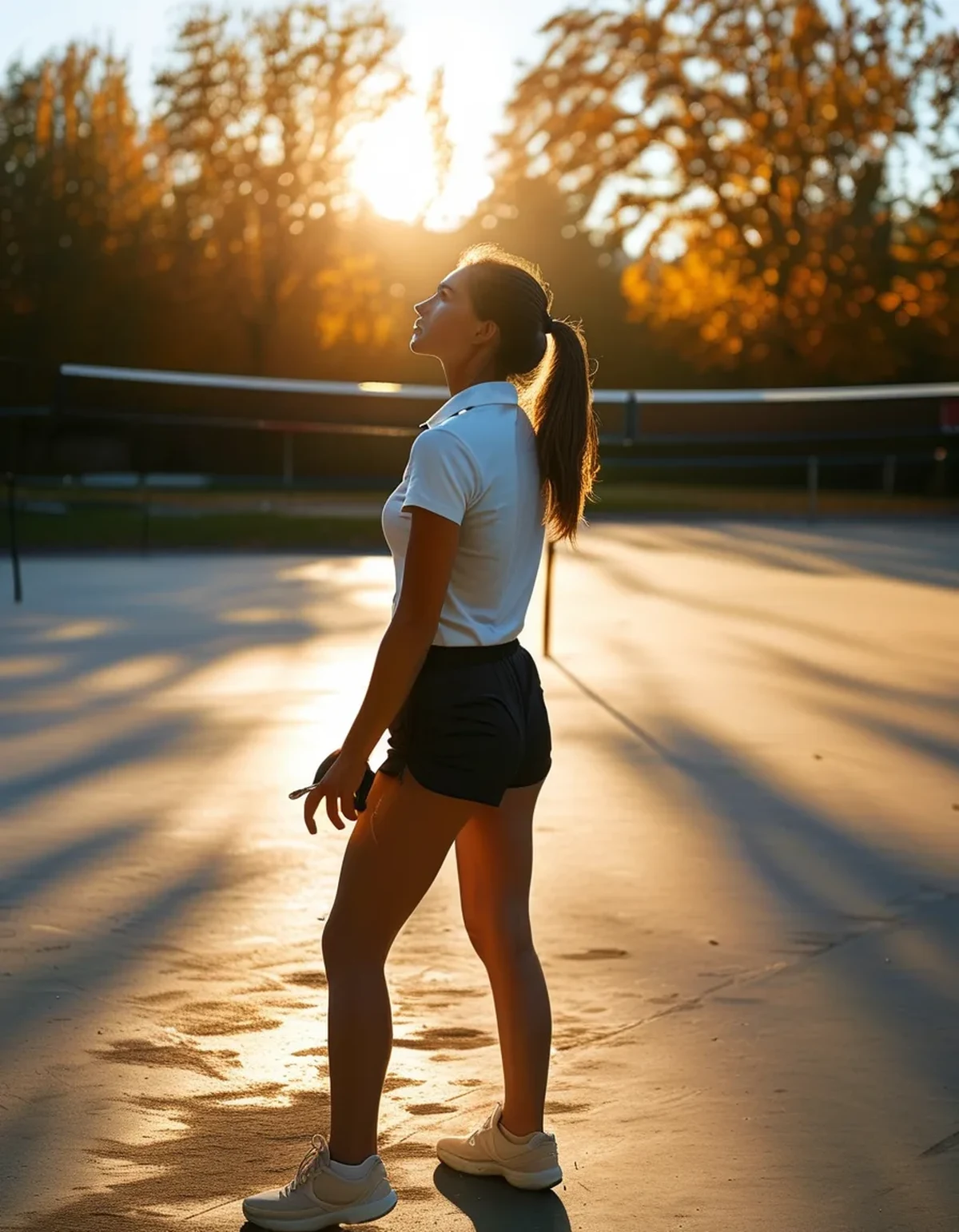
Seen here: UPF 50+ Pleated Running Skort with 26” Leggings & Pockets — shop similar styles on bubblelime.com
Keep Reading
This article is for general informational and styling purposes only. Fit, sizing, and product availability may vary.