Complete Guide: Why Your Third Shot Drop Falls Apart in the Second Hour
Quick Answer: The third shot drop degrades in hour two because leg fatigue raises your contact point, tired hands grip tighter and add unwanted pace, and reduced footwork means you hit more balls from a stationary or off-balance position. The shot itself has not been forgotten — the platform it is hit from has changed. Fixing the legs and the grip pressure restores it faster than practicing the shot does.
Hour one: your drops land soft in the kitchen and you get to the line.
Hour two: they sail long, then you overcorrect and dump three into the net, and you cannot work out what you changed.
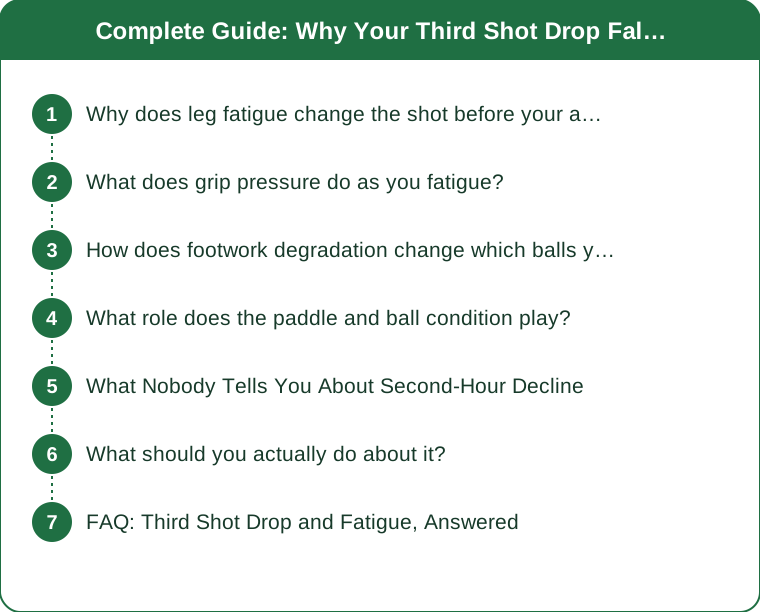
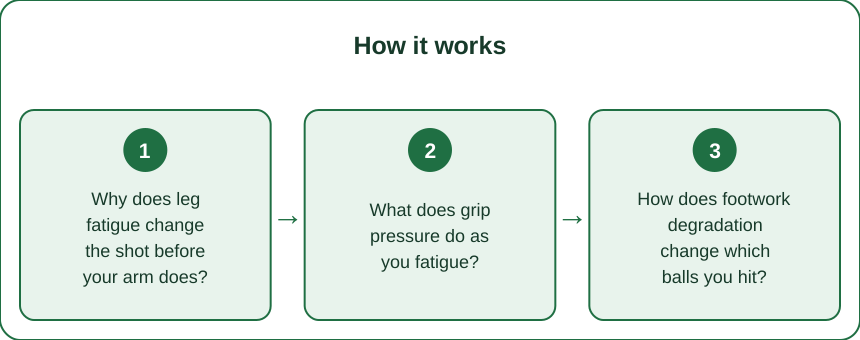
Why does leg fatigue change the shot before your arm does?
Because the drop is a legs-first shot, and almost nobody thinks of it that way.
The drop requires a low contact point. Getting under the ball and lifting it softly over the net requires bending your knees and dropping your center of gravity. That is leg work, sustained across every single third shot in a session.
Tired legs raise your contact point without you noticing. As quads and glutes fatigue, your knee bend reduces by a few inches. You still feel like you are getting low, because your perception of effort is unchanged — you are working just as hard for less depth.
A higher contact point changes the required swing path. From higher up, the same soft lifting motion sends the ball further, because you are hitting with less upward angle and more forward travel. The result is a drop that sails deep, which is exactly what most players see first.
Then the overcorrection arrives. You feel the ball going long, so you take pace off. But the actual problem was contact height, so removing pace from a too-high contact produces a ball that lands in the net. That is the second-phase symptom, and it is why the shot feels like it has completely deserted you.
The diagnostic is simple. If your drops go long first and into the net second, that sequence is a contact height problem, not a touch problem. Touch problems are random; this pattern is ordered.
Which is why practicing the shot when tired teaches the wrong thing. Hitting a hundred drops from a fatigued, high contact point reinforces a stroke calibrated to a position you do not use when fresh.
What does grip pressure do as you fatigue?
It rises, and rising grip pressure is the enemy of every soft shot in the sport.
Tired hands grip harder to maintain control. This is a reflexive compensation, not a decision. As forearm muscles fatigue, the nervous system recruits more force to achieve the same perceived stability.
A tight grip transmits more energy to the ball. A soft grip lets the paddle give slightly on contact, absorbing pace — which is precisely the mechanism a drop shot depends on. Grip tightly and the paddle becomes a rigid surface that returns energy rather than absorbing it.
The added pace is small but decisive. A drop shot has a very narrow margin. A few extra miles per hour is the difference between landing in the kitchen and landing at your opponent’s feet at the line, which hands them the attack.
Grip pressure also kills feel. Fine touch depends on feedback through the hand, and a clenched hand transmits far less usable information. Players describe this as losing feel, which is accurate but usually misattributed to concentration.
It is worse in cool weather. Cold hands lose fine motor control before they lose strength, which pushes you toward a tighter grip to compensate. An October evening session degrades touch faster than a July one at the same duration.
The fix is a conscious check, not a technique change. Rate your grip one to ten between points. Aim for a three or four on a drop. Most players discover they are at seven and did not know it.
How does footwork degradation change which balls you hit?
It changes your position, and position dictates what shot is even available.
Fresh footwork gets you behind the ball. Being behind and slightly under a ball lets you swing forward and upward, which is the drop shot’s natural geometry.
Tired footwork leaves you reaching. One step short means you contact the ball out in front and to the side, with the paddle face at an angle you did not choose. From there, a controlled drop is genuinely much harder — not mentally, mechanically.
Split step quality drops first. The small hop that preloads your legs before your opponent’s contact is the first thing fatigue erodes, and losing it costs you roughly half a step on every ball. Half a step is exactly the difference between behind the ball and reaching for it.
Recovery to position slows. After hitting, returning to a ready position takes longer, which means the next ball starts from further out of position — the deficit compounds through a rally rather than resetting.
Players compensate by hitting harder. If you cannot get into position for a soft shot, driving the ball becomes the easier option. This is why players who start a session dropping well end it driving everything, and then conclude they were never good at the drop to begin with.
Watch your own pattern across a session. Count the ratio of drops to drives in your first thirty minutes and your last thirty. The shift is almost always larger than players expect, and it is a footwork story rather than a decision-making one.
What role does the paddle and ball condition play?
More than most players account for, and both change measurably over a long session.
Outdoor balls soften and go out of round. A ball that has been hit for two hours plays differently — it deforms slightly on contact and rebounds less predictably. Drop shots are the most sensitive shot to ball condition because they have the least margin.
Temperature changes ball behavior within a session. A ball warms up with play and cools between games. Cold balls are harder and bounce lower; warm balls are livelier. An evening session that starts at 70 degrees and ends at 55 is playing two different balls.
Paddle face wear affects spin more than pace. A textured surface that has accumulated two hours of ball residue and court dust grips less. If you rely on a bit of spin to control the drop, that control is quietly reducing.
Court surface temperature changes bounce height. A hot court produces higher bounces than a cool one, which changes where you contact the ball relative to your body. In autumn, courts cool noticeably in the last hour of daylight.
Wind is the underestimated variable in fall. Afternoon wind that picks up in the second hour affects a soft, high-arc shot far more than a drive. Players attribute the resulting errors to their own technique when the shot was struck fine.
Practical response: swap to a fresh ball for the last game if you have one, and consciously recalibrate rather than assuming your stroke broke. A single game of deliberate recalibration is worth more than an hour of frustrated adjustment.
What Nobody Tells You About Second-Hour Decline
Nutrition affects touch shots before it affects power. Fine motor control degrades with falling blood glucose earlier than force production does. A player two hours in without food will lose their drop shot while their drives are still fine, which is a confusing experience that has nothing to do with technique.
Hydration matters more for the drop than for anything else. Mild dehydration affects concentration and fine motor coordination, both of which the drop depends on disproportionately. Most recreational players drink far less than they need across a long social session.
Social play hides fatigue. Between-game chatting means your heart rate drops, so you feel recovered when your legs are not. This is why casual play produces the second-hour decline more reliably than structured drilling does — the recovery is real but only cardiovascular.
Your opponents get better as you get worse. In a fixed group, everyone fatigues, but drives and dinks degrade less than drops do. That shifts the whole game toward faster exchanges, which further reduces your opportunities to hit the shot you were practicing.
The last game is where technique errors get learned. Whatever compensation you improvise in hour two — a shorter swing, a wristy flick, standing more upright — gets practiced under fatigue and shows up next session. This is the real cost of pushing through, and it is why some players get worse over a season of frequent play.
Ending on a good game matters more than playing one more. Stopping while the shot is still working leaves you with the correct pattern reinforced. This is unglamorous advice and it is genuinely what separates players who improve from players who plateau.
What should you actually do about it?
Address the platform, not the shot, and manage the session deliberately.
Build leg endurance off the court. Wall sits, split squats, and step-ups two or three times a week. 3 sets of 8 per side with 90 seconds rest is enough. The drop shot lives on your legs, so leg endurance is drop shot practice.
Check your grip pressure between every point in the second hour. One to ten, aim for three or four. This single habit does more for second-hour touch than any technical adjustment.
Reinstate the split step consciously. When you notice the drop going long, the first thing to check is whether you are still split stepping. Most players find they stopped twenty minutes earlier.
Eat and drink on a schedule, not on thirst. Something with carbohydrate at the 60-minute mark, and water every changeover. Touch shots are the first casualty of running low, and the effect is fully preventable.
Do a deliberate recalibration game. When drops start sailing, spend one game consciously getting lower rather than taking pace off. Nine times out of ten the contact height was the problem, and the fix is a knee bend rather than a softer hand.
Practice drops when fresh, always. Do drop work in the first thirty minutes of a session. Drilling touch shots on tired legs trains a stroke you will never use when it matters.
Know when to stop. If your drops have gone and your footwork has gone with them, the next hour is not improving anything. Ending on a strong game is a legitimate strategy, not an excuse.
FAQ: Third Shot Drop and Fatigue, Answered
Should I just drive more when I get tired?
As a tactical adjustment for the last game, that is reasonable — playing to what still works is smart. As a habit it is a trap, because you stop developing the shot that lets you get to the line, and the drop is what raises your ceiling as a player.
How do I know if it is fatigue or a real technique problem?
The timing tells you. A technique problem is present from the first ball of the session. A fatigue problem appears at a consistent point — usually 60 to 90 minutes in — and disappears after rest. Film your first ten drops and your last ten; the contact height difference is usually visible immediately.
Does a lighter paddle help with second-hour fatigue?
Marginally for arm fatigue, but the limiting factor is legs, not paddle weight. Players who switch to a lighter paddle to solve this usually find the problem unchanged, and they also lose some stability on drives. Fix the legs first.
Is this worse in cold weather?
Yes, in three ways. Cold hands lose fine motor control, cold muscles fatigue faster in the absence of a proper warm-up, and cold balls play lower and deader. Autumn and winter sessions need a longer warm-up and more conscious grip checks than summer ones do.
TL;DR:
- The drop is a legs-first shot; tired legs raise your contact point and the ball sails long
- The long-then-net sequence is diagnostic — it is contact height, not touch
- Grip pressure rises with fatigue and a tight grip returns energy instead of absorbing it
- Lost split steps leave you reaching, which removes the drop as an available option
- Practice drops in the first 30 minutes, never on tired legs, and end on a game that works
- Build leg endurance off court — that is the actual drop shot training most players skip
The reassuring part is that nothing you learned has gone anywhere. The stroke is intact; the platform it is hit from sank two inches. Get lower, loosen your hand, and it comes straight back in the same game.
See It in Motion
Seen here: UPF 50+ Adjustable A-Line Running Skort with Pockets — shop it on bubblelime.com
Keep Reading
This article is for general informational and styling purposes only. Fit, sizing, and product availability may vary.