Pickleball for Beginner Women: Why Everyone Is Obsessed (and How to Start)
Quick Answer: Pickleball takes about 20 minutes to learn. Three rules cover almost everything: serve underhand and diagonally, the ball must bounce once on each side before anyone volleys (the double bounce rule), and you can’t hit the ball out of the air while standing in the 7-foot “kitchen” zone by the net. Games go to 11, win by 2, usually doubles. Start with a $40–60 paddle bundle and — more importantly — proper court shoes.
Twenty minutes. That’s how long it takes from “I’ve never held a paddle” to “I’m playing actual points and enjoying it.”
No other sport does that. Tennis takes months before a rally feels like a rally. Pickleball hands you a fun game almost immediately, on a court a third the size, with a ball that physically refuses to go too fast.

What pickleball actually is
A badminton-sized court — 20 by 44 feet, about a third of a tennis court. A net slightly lower than a tennis net (34 inches at the center). Solid paddles, no strings. And a hollow plastic ball with holes in it that’s aerodynamically incapable of the pace a tennis ball reaches.
That combination is the entire reason it works. The small court means less running. The slow ball means rallies actually last. The low pace means your knees, ankles, and lungs are dramatically less abused than in tennis.
It’s also genuinely social in a way most sports aren’t. You’re standing close enough to your partner and opponents to chat between points, and doubles is the default. Roughly half the addiction is the conversation.
The rules in plain English
1. The serve. Underhand, contacted below your waist, hit diagonally to the opposite service box. It must clear the kitchen — the 7-foot no-volley zone on each side of the net. Serve from behind the baseline.
2. The double bounce rule. After the serve, the return must bounce before it’s hit, and the serving team’s next shot must also bounce. So: serve bounces, return bounces, and then anyone can volley. This one rule is what stops the serving team from just rushing the net and smashing everything.
3. The kitchen (non-volley zone). You cannot hit the ball out of the air while standing in the kitchen, or while touching the kitchen line. You can step in to play a ball that has bounced. Momentum counts too — if your follow-through carries you into the kitchen after a volley, that’s a fault.
4. Scoring. Games go to 11, win by 2. Only the serving team can score. In doubles, the score is called as three numbers: your score, their score, and whether you’re the first or second server (e.g. “4–2–1”).
Everything else you’ll pick up by playing. Genuinely — pickleball regulars are famously happy to walk a newcomer through it, and most beginner sessions include a five-minute rules explanation from someone delighted to give it.
Gear: spend $50, not $500
Paddle: $40–60. A beginner bundle with two paddles and balls is completely adequate for your first several months. Paddle technology is real but it’s irrelevant until your technique is consistent enough to notice the difference.
Court shoes: the one thing worth real money. This is where the budget should go. Pickleball is played almost entirely with lateral movement — quick side steps, sudden stops, direction changes. Running shoes are built for forward motion and have soft, unstable sides, which is precisely how people roll ankles on a pickleball court. Court shoes (tennis or pickleball specific) have lateral support built in. $70–120.
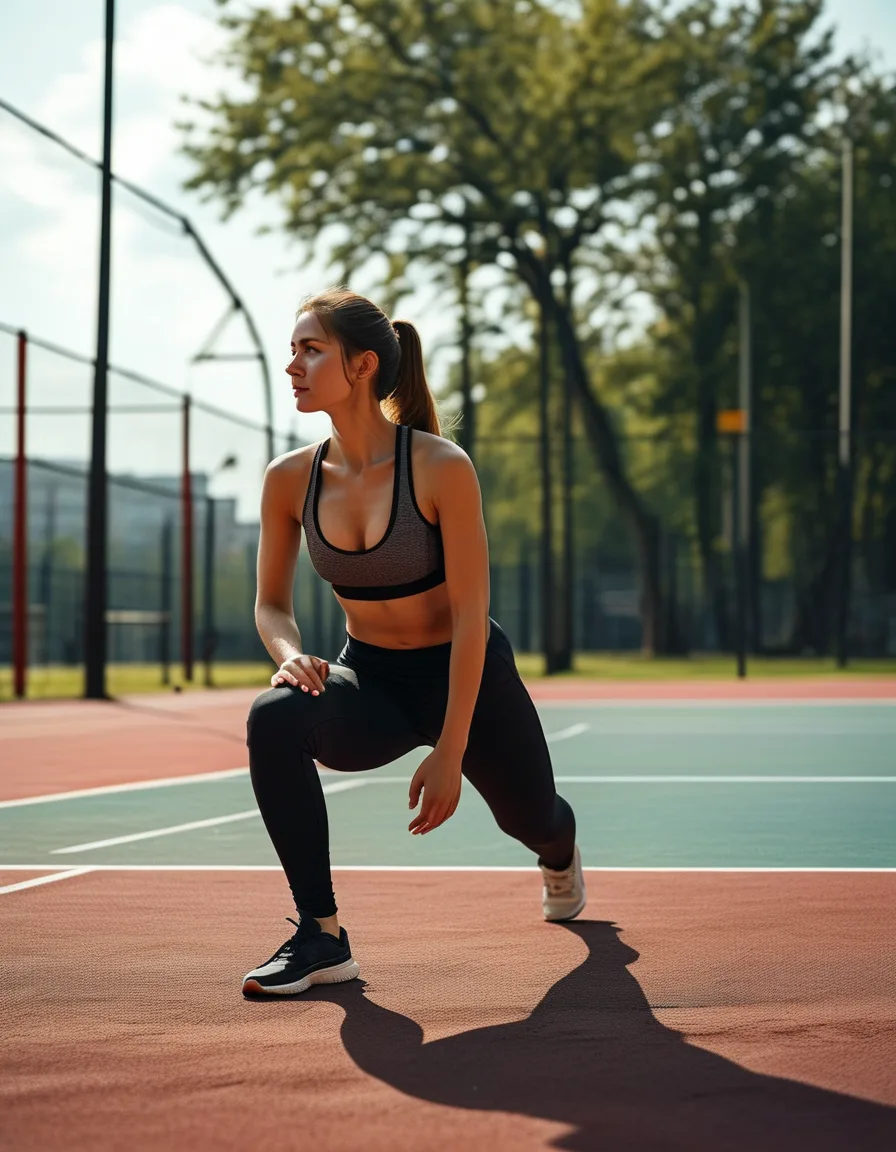
Clothes: anything you can lunge in. A skort with pockets is genuinely practical — you need somewhere to keep the second ball.
Outdoors: sunscreen, a visor or hat, and sunglasses. Outdoor pickleball courts have no shade and sessions run long.
Balls: indoor and outdoor balls are different. Outdoor balls have smaller, more numerous holes and are harder, to handle wind. Buy the right ones for where you play.
Your first session plan
Find beginner open play. Local rec centers, community parks, and YMCAs run sessions that are cheap or free and grouped by level. Look for anything labeled “beginner,” “intro,” or “open play 2.0–2.5.” Showing up alone is completely normal — you’ll be paired up.
Day one strategy, in order of importance:
- Get your serve in. Not fast, not spinny. In. A missed serve is a free point for them and unforced serve errors decide most beginner games.
- Return deep. A deep return pushes your opponents back and buys you time to move up.
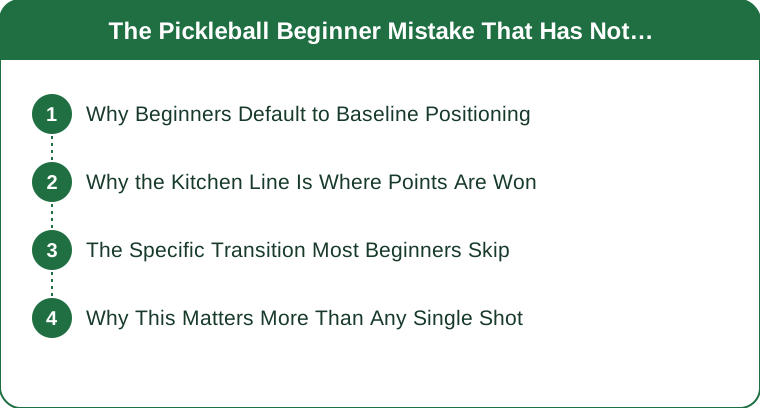
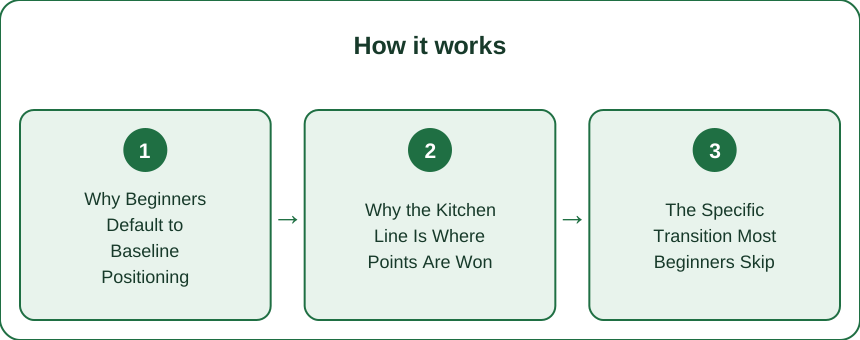
- Move to the kitchen line. This is the single biggest tactical thing beginners don’t know: points are won at the net, not the baseline. Get to the kitchen line with your partner and stay there.
- Stay level with your partner. Move up and back together, like you’re connected by a rope. Gaps between partners are where balls go.
Expect to feel clumsy for about 45 minutes. Expect to be rallying, laughing, and slightly out of breath by hour one.
5 mistakes everyone makes in their first month
1. Standing at the baseline. The most common and most costly. Beginners retreat to the back like it’s tennis. Get to the kitchen line — the whole game lives there.
2. Swinging too hard. The ball doesn’t reward power the way a tennis ball does. Soft, controlled shots that land in the kitchen (the “dink”) beat hard shots that sail long. Almost every beginner over-hits.
3. Wearing running shoes. Say it again: lateral support. This is the injury one.
4. Forgetting the double bounce rule. Everyone volleys the return in their first game. Everyone. It’s fine.
5. Skipping the warm-up. Pickleball feels casual, which is exactly why people go from a car seat to explosive lateral movement with no transition. Five minutes of walking, leg swings, and easy dinking prevents a lot of calf and Achilles trouble.
Why it’s sneaky-great exercise
A casual hour of doubles involves constant light movement, quick lateral steps, lunges, and reflex volleys. It’s meaningful cardio delivered in a package that feels like recess rather than exercise.
More importantly for the long term, it trains balance and agility — the two capacities most directly tied to staying independent and fall-free later in life — at a fraction of the joint impact of running.
And the community effect is the real secret. A standing Tuesday session with people who notice when you don’t show up is the stickiest fitness habit ever devised. You won’t need discipline. You’ll need court time.
Playing safely
Pickleball’s injury profile is real, mostly ankles, calves, and Achilles tendons — a consequence of sudden lateral movement in a sport that feels gentle. Warm up for five minutes before playing. Wear court shoes. Don’t back-pedal for lobs; turn and run, because falling backwards is how wrists and hips get broken. Check with a clinician before starting if you have heart conditions, significant joint problems, or have been inactive for a long stretch. And build up gradually — going from zero to four sessions a week in month one is how people end up with an inflamed Achilles.
FAQ
Is pickleball easy to learn for beginners?
Unusually so. Most people are playing real points within 20 minutes. The court is small, the ball is slow, the paddle is easy to control, and the scoring is simple. It’s widely considered the most beginner-friendly racquet sport.
What is the kitchen rule in pickleball?
The kitchen is the 7-foot non-volley zone on each side of the net. You can’t hit the ball out of the air while standing in it or touching its line, and your momentum can’t carry you into it after a volley. You can step in to play a ball that has already bounced.
What do I need to start playing pickleball?
A beginner paddle (a $40–60 bundle is fine), balls appropriate to indoor or outdoor play, and — the one thing worth spending on — proper court shoes with lateral support. Then find a beginner open play session at a local rec center or park.
TL;DR:
- Three rules: underhand diagonal serve, double bounce before anyone volleys, no volleying from the kitchen.
- Games to 11, win by 2, only the serving team scores.
- Spend $40–60 on a paddle bundle and $70–120 on court shoes. The shoes matter more.
- Running shoes are the main injury risk — pickleball is a lateral-movement sport.
- Day one: get serves in, return deep, and move to the kitchen line with your partner.
- Points are won at the net, not the baseline. Beginners stand too far back.
- Warm up for five minutes. The casual feel is exactly why people strain calves and Achilles.
See It in Motion
Seen here: UPF 50+ Adjustable A-Line Running Skort with Pockets — shop it on bubblelime.com
Keep Reading
This article is for general informational and styling purposes only. Fit, sizing, and product availability may vary.