Doubles Communication: The Partner Play That Wins Pickleball Matches
Pickleball doubles is won between partners more than between teams — the called balls, the covered gaps, the chemistry that beats better players — and communication is a learnable system, not a personality trait. The partner-play guide: the calls, the coverage and the chemistry.

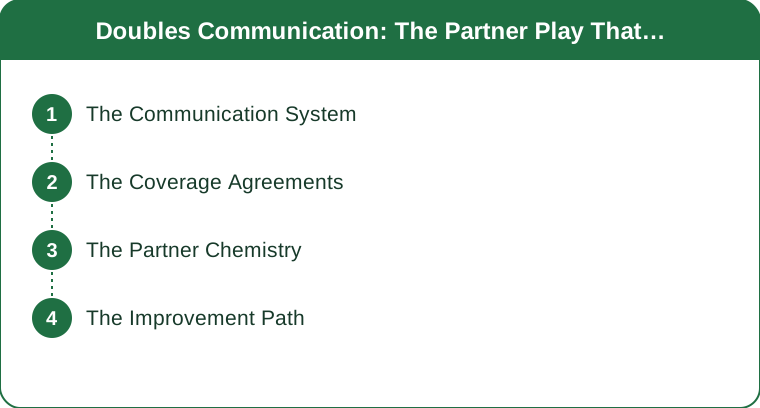
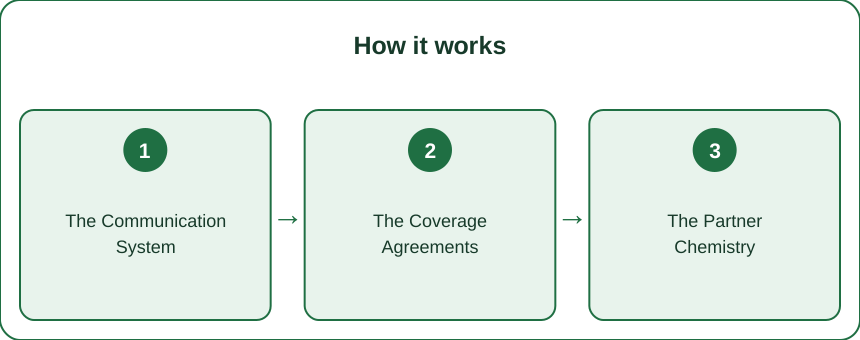
The Communication System
The words that win: the call vocabulary (the ‘mine-yours’ standard on every middle ball — the caller committing, the partner clearing; the silence being the error, not the wrong call), the ‘bounce’ and ‘out’ calls (the partner’s better view on baseline balls — the out-call trust from the line-calling etiquette; the ‘bounce it’ discipline on high balls drifting long), the switch-and-stay calls (the crossing coverage announced — the ‘switch’ that prevents the both-players-one-side disaster; the ‘I go, you stay’ clarity on lobs), the pre-point signals (the serve-and-return plans whispered — the third-shot intention shared; the poach signals for the ambitious per the strategy doctrine), the positive-noise layer (the point-over reset — the paddle tap ritual, the ‘good idea’ on failed attempts; the partner-morale doctrine: the next point played by two confident players or lost by one deflated one), and the volume honesty (the call made LOUD — the polite murmur causing the collision it tried to prevent).
The Coverage Agreements
The court split, pre-agreed: the middle-ball default (the forehand-takes-middle convention as the starting rule — the stronger-player-middle variation agreed in advance; the middle being where unagreed teams bleed points), the lob-coverage plan (the ‘you drop, I cover’ agreement — the over-your-partner lob’s assigned responder; the switching choreography rehearsed per the kitchen doctrine), the stacking basics (the positioning system for maximizing the stronger forehand — the beginner-friendly partial version; the full stack as the later graduation), the kitchen-line unity (the advance-together doctrine from the strategy chapters — the tethered-by-rope image; the one-up-one-back formation being the losing shape), the weakness-covering honesty (the partner conversations about backhand sides and overhead comfort — the coverage tilted toward strengths without ego; the team that plans around reality beating the one that pretends), and the chaos protocols (the scramble points’ simple rule — the closest-ball-calls and the recover-to-position habit).

The Partner Chemistry
The human layer: the error etiquette (the partner’s miss met with a tap and a next-ball — the coaching-mid-match ban unless invited per the etiquette doctrine; the frustration that leaks poisoning the pairing), the strength-mapping conversation (the pre-match two minutes — the ‘I’m weaker on backhand lobs, love the poach’ exchange; the honesty that lets tactics work), the momentum management (the timeout-and-slow-down craft when spiraling — the between-point breath from the pressure doctrine; the partner who resets the pace being the team’s thermostat), the celebration culture (the good points marked genuinely — the fun-remembering from the joy doctrine; the recreational match’s actual purpose kept in view), the regular-partner development (the standing partnership’s compounding advantage — the wordless coverage that develops across months; the partner-practice sessions on weaknesses per the drill doctrine), and the rotating-partner grace (the open-play adaptability — the quick strength-map chat with each new partner; the flexible-doubles skill being its own rating point).
The Improvement Path
Building the partnership: the drill menu (the two-person kitchen drills — the dink crosscourts with communication practice built in; the lob-and-switch rehearsals; the middle-ball rapid-fire that forces calls), the match-review habit (the post-game two-minute debrief — the ‘what worked’ emphasis with one fix each per the feedback doctrine), the video option (the filmed match revealing the coverage gaps — the one-up-one-back habit visible from the fence per the video doctrine), the lesson-together move (the doubles clinic as a pair — the shared vocabulary from coached sessions), the tournament test (the local round-robin as the partnership’s exam — the pressure that reveals what practice hides per the competition doctrine), and the closing truth (the communication being free rating points — the 3.5 team that talks beating the 4.0 pair that doesn’t; the partnership as pickleball’s real unit; the game, at its best, being a conversation with paddles). Call everything loud, advance together, tap paddles after every point: the doubles, actually doubled.
Call every middle ball loud (‘mine/yours’), agree forehand-takes-middle and lob coverage in advance, and advance to the kitchen line together like you’re tethered. Paddle-tap after every point — a talking 3.5 team beats a silent 4.0 pair.
See It in Motion
Seen here: UPF 50+ Adjustable A-Line Running Skort with Pockets — shop it on bubblelime.com
Keep Reading
This article is for general informational and styling purposes only. Fit, sizing, and product availability may vary.