Why Your Paddle Weight Might Be the Real Cause of Wrist Fatigue
Quick Answer: A paddle that’s heavier than your wrist and forearm can comfortably decelerate on each swing forces small stabilizing muscles to work overtime shot after shot, and this cumulative micro-fatigue is a commonly overlooked cause of wrist soreness that grip technique alone can’t fully fix.
Many players troubleshoot wrist pain by adjusting grip or technique first, when the paddle itself is frequently the more direct variable.

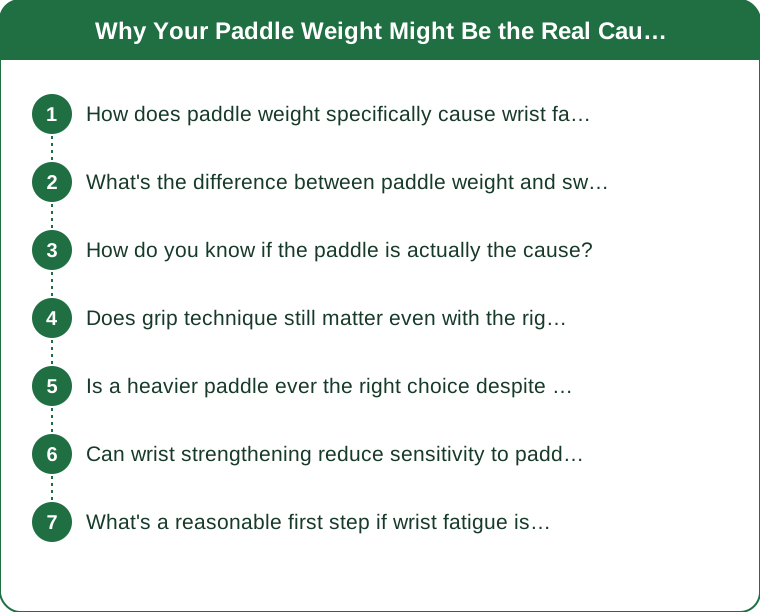
How does paddle weight specifically cause wrist fatigue?
Every swing requires the wrist and forearm to both accelerate and then decelerate the paddle at contact and follow-through, and a heavier paddle — or one with weight concentrated toward the head rather than the handle — demands proportionally more stabilizing effort from smaller wrist muscles on every single shot. Over dozens of exchanges in a match, that repeated micro-strain compounds in a way that a single swing wouldn’t reveal, which is why the fatigue often shows up gradually over a session rather than immediately.
What’s the difference between paddle weight and swing weight?
Total paddle weight is what a scale shows, but swing weight — how the weight is distributed along the paddle’s length — often matters more for wrist strain than the raw number. A lighter paddle with weight concentrated at the head can actually feel harder to control and more fatiguing than a slightly heavier paddle with more balanced or handle-weighted distribution, which is a distinction many players overlook when paddle shopping by weight alone.
How do you know if the paddle is actually the cause?
A useful test is borrowing a noticeably lighter paddle for a session and noting whether wrist fatigue is meaningfully reduced at similar play volume — if it is, paddle weight is likely a real contributing factor rather than purely a technique issue. Persistent fatigue that doesn’t change across different paddles points more toward grip or swing mechanics as the primary driver instead.

Does grip technique still matter even with the right paddle weight?
Yes, considerably — a death-grip hold that never relaxes between shots adds constant low-level tension that compounds with any paddle weight issue, so addressing both grip looseness and paddle weight together tends to produce better results than fixing either one alone.
Is a heavier paddle ever the right choice despite this?
Sometimes — heavier paddles can offer more power and stability for players with strong, well-conditioned wrists and forearms, so the right weight is genuinely individual rather than universally lighter-is-better; the key is matching paddle weight to current wrist conditioning, not maximum available power.
Can wrist strengthening reduce sensitivity to paddle weight over time?
Yes — forearm and wrist conditioning exercises done consistently over several weeks can increase tolerance for a given paddle weight, meaning a paddle that currently causes fatigue might not after a period of targeted strengthening, which is a more sustainable long-term fix than only changing equipment.
What’s a reasonable first step if wrist fatigue is a recurring issue?
Testing a paddle roughly half an ounce to a full ounce lighter than your current one for a few sessions is a low-cost way to isolate whether weight is a meaningful factor, before assuming the issue is purely technique-related or investing in wrist braces and strengthening protocols.
TL;DR:
- Paddle weight forces small wrist muscles to decelerate every swing, compounding over a match
- Swing weight distribution often matters more than total paddle weight alone
- Testing a lighter paddle for a few sessions is a simple way to isolate the cause
- Grip tension and paddle weight often compound each other rather than acting separately
- Wrist conditioning over time can increase tolerance for a given paddle weight
Before assuming it’s purely a technique problem, a lighter paddle test is worth trying first.
See It in Motion
Seen here: UPF 50+ Pleated Running Skort with 26” Leggings & Pockets — shop similar styles on bubblelime.com
Keep Reading
This article is for general informational and styling purposes only. Fit, sizing, and product availability may vary.