The Split-Step Timing Fix That Instantly Improves Pickleball Court Coverage
Quick Answer: A split-step — a small, well-timed hop landing just as your opponent contacts the ball — resets your feet into a ready position and lets you push off explosively in any direction, and mistiming it (or skipping it) is one of the most common reasons recreational players feel a step slow.
Fast hands get the highlight reel, but footwork timing is quietly the bigger factor in actually reaching the ball in position to use them.

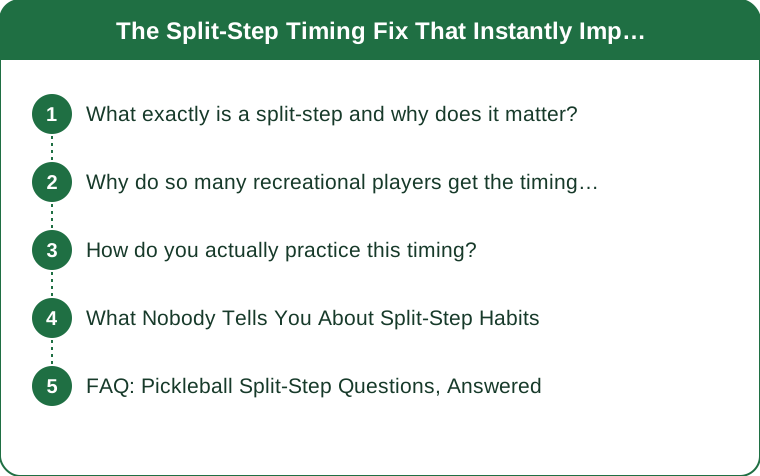
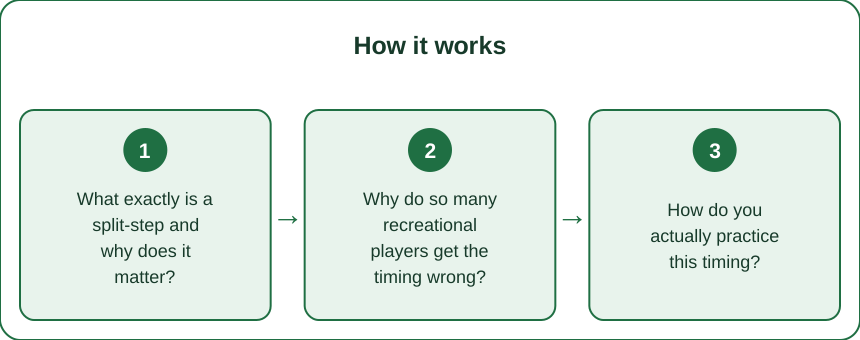
What exactly is a split-step and why does it matter?
A split-step is a small, quick hop performed just before your opponent contacts the ball, landing with feet shoulder-width apart and knees slightly bent — a neutral, athletic ready position. This timing lets your leg muscles load and react explosively the instant you see which direction the ball is going, rather than starting flat-footed from a standstill.
Without it, the first movement toward any ball starts from a static position, costing a meaningful fraction of a second that often means arriving late and off-balance.
Why do so many recreational players get the timing wrong?
The most common error is split-stepping too early or too late — hopping well before or after the opponent’s contact point, which means you land back on flat feet by the time you actually need to react. The timing has to sync specifically to their contact moment, not to when the ball crosses the net or any other visual cue.
This takes deliberate practice to internalize, since it runs counter to the instinct to simply watch the ball’s flight rather than the opponent’s paddle.

How do you actually practice this timing?
Shadow drilling — practicing the split-step timing against a partner or ball machine feeding shots, without worrying about the return shot itself — isolates the skill from the pressure of also making a good return. Focus purely on landing the hop right as contact happens, dozens of repetitions in a row.
Once the timing feels automatic in drilling, it transfers into live play far more reliably than trying to consciously time it mid-point for the first time.
What Nobody Tells You About Split-Step Habits
Many players split-step consistently on serves and returns (where it’s more habitual) but completely forget it during fast net exchanges and dinking rallies — exactly the situations where quick, reactive footwork matters most. Building the habit specifically into net play, not just the opening shots of a point, is where most of the real gain is.
Also underrated: a split-step doesn’t need to be a big, obvious hop — a subtle, small weight shift accomplishes the same reactive-readiness benefit without wasting energy or throwing off balance during fast exchanges.
FAQ: Pickleball Split-Step Questions, Answered
Does the split-step work the same at the net as at the baseline?
The principle is identical, though at the net the hop needs to be smaller and quicker given the much shorter reaction window during fast dinking exchanges.
How long does it take to build this into an automatic habit?
Most players notice it becoming more automatic within a few weeks of deliberate drilling, particularly if practiced specifically during net-play drills, not just serves.
Can improving footwork timing alone measurably improve my game?
Yes — many coaches consider footwork and positioning a bigger practical lever for intermediate players than adding new shots, since better positioning makes existing shots far more effective.
TL;DR:
- Split-step timing should sync to your opponent’s contact moment, not the ball’s flight
- Mistimed or skipped split-steps are a common reason players feel a step slow
- Drill the timing in isolation before expecting it to hold up in live play
- Build the habit into net exchanges specifically, not just serves and returns
See It in Motion
Seen here: UPF 50+ Adjustable A-Line Running Skort with Pockets — shop it on bubblelime.com
Keep Reading
This article is for general informational and styling purposes only. Fit, sizing, and product availability may vary.