The Third Shot Drop: Pickleball's Most Important Shot Is Also Its Slowest
Quick Answer: The third shot drop — a soft arcing shot from the baseline that lands in the opponents’ kitchen — is pickleball’s momentum-flipper: it neutralizes the serving team’s positional disadvantage and buys time to reach the net. Aim for an apex on your side of the net, accept that it takes hundreds of reps, and use the drop-or-drive decision rule: drop when they’re at the net, drive when they hang back.
New players fall in love with power — the satisfying smack of a hard third shot. Then they meet a team that calmly blocks their heat back at their feet, and discover the game’s uncomfortable truth: the slowest shot in pickleball is the one that wins the most points.

Why does the serving team need a special third shot at all?
Pickleball’s structure creates a built-in imbalance: the receiving team gets to the net first (the returner’s partner is already there; the returner follows the return in), while the serving team is stuck at the baseline by the double-bounce rule.
Net position is dominant in this sport — the team at the kitchen line hits down; the team at the baseline hits up. So the serving team’s third shot is played from the worst spot on court against opponents in the best spot.
A hard drive into two ready net players mostly feeds them blocks and put-aways. The drop does something smarter: a soft, arcing ball that lands in the kitchen cannot be attacked — it forces the net team to hit up gently — and while it floats, the serving team walks calmly to the net. One shot converts ‘defending from the back’ into ‘equal footing at the kitchen line.’ That’s why coaches call it the most important shot in the game.
How do I actually hit a drop that lands soft?
The mechanics:
- Low-to-high lift, from the legs: bend knees, take the ball out front, and lift with a gentle low-to-high swing — the motion is closer to tossing an egg underhand than hitting a groundstroke. Power comes off, touch goes on.
- The apex secret: aim for the ball’s highest point to happen on your side of the net — it then descends into the kitchen. Balls that peak over or past the net arrive high and attackable, which is a drop in name only.
- Grip pressure 3/10: a squeezed grip pops the ball long; soft hands absorb and guide.
- Target depth over perfection: landing anywhere in the kitchen that forces an upward contact wins the exchange — chasing the perfect net-skimmer produces net errors that cost more than slightly-deep drops ever do.
The progression that builds it: start at the kitchen line dropping to a partner (short-court touch), step back to mid-court, then to the baseline — advancing only when 7 of 10 land unattackable. Hundreds of reps is the honest price; every rec-league player who owns this shot paid it.
Myth vs Fact: Third Shot Edition
Myth: Always drop — the drive is a beginner habit. Fact: The modern game mixes both. The decision rule: drop when both opponents hold the net; drive when someone lags back, sits mid-court, or has a weak volley. Drives also set up the ‘shake and bake’ (drive + partner crash). The drop is the default against good positioning, not a religion.
Myth: A great drop ends the point. Fact: A great drop starts the point on your terms — it’s a neutralizer, not a winner. Expect the opponents’ soft return, and treat your drop as the ticket that admits you to the kitchen-line rally you’re actually trying to win.
Myth: If my drop gets attacked, I need more backspin. Fact: Attacked drops are almost always height errors (apex past the net), not spin deficiencies. Fix the arc first — flat-but-well-arced drops from rec players work fine. Spin is a garnish on geometry.
The humbling reframe: the third shot drop is less a shot than a patience test with a paddle — the player willing to hit a slow ball under pressure controls the fast ones that follow.
FAQ: Third Shot Drop Questions, Answered
Should I run to the net immediately after dropping?
Move in behind the quality of your drop: a good one, advance fully; a so-so one, split-step at mid-court, absorb the reply, and drop again (the fifth shot drop is a real and respectable pattern). Sprinting blindly behind a high drop is how you eat body shots.
Forehand or backhand drops first?
Drill the forehand until reliable, then the backhand — but in games, position early so the forehand takes most thirds. A slightly-run-around forehand drop beats a stretched backhand one at every rec level.
My drops die at the net when I’m nervous — why?
Pressure tightens grips, and tight grips kill the lift. Pre-shot: exhale, loosen to 3/10, and pick the apex spot before the ball arrives. Choosing a target occupies the brain that would otherwise clench.
TL;DR:
- The drop neutralizes the serving team’s built-in disadvantage: unattackable kitchen ball + time to reach the net
- Mechanics: lift from the legs, apex on YOUR side, grip at 3/10, kitchen-depth over perfection
- Decision rule: drop vs net-holders, drive vs laggers — and follow in behind the drop’s quality
- Build it kitchen-line → mid-court → baseline; hundreds of reps is the honest tuition
Power gets the highlight; the slow ball gets the net — and the net gets the game. This is general information, not medical advice.
See It in Motion
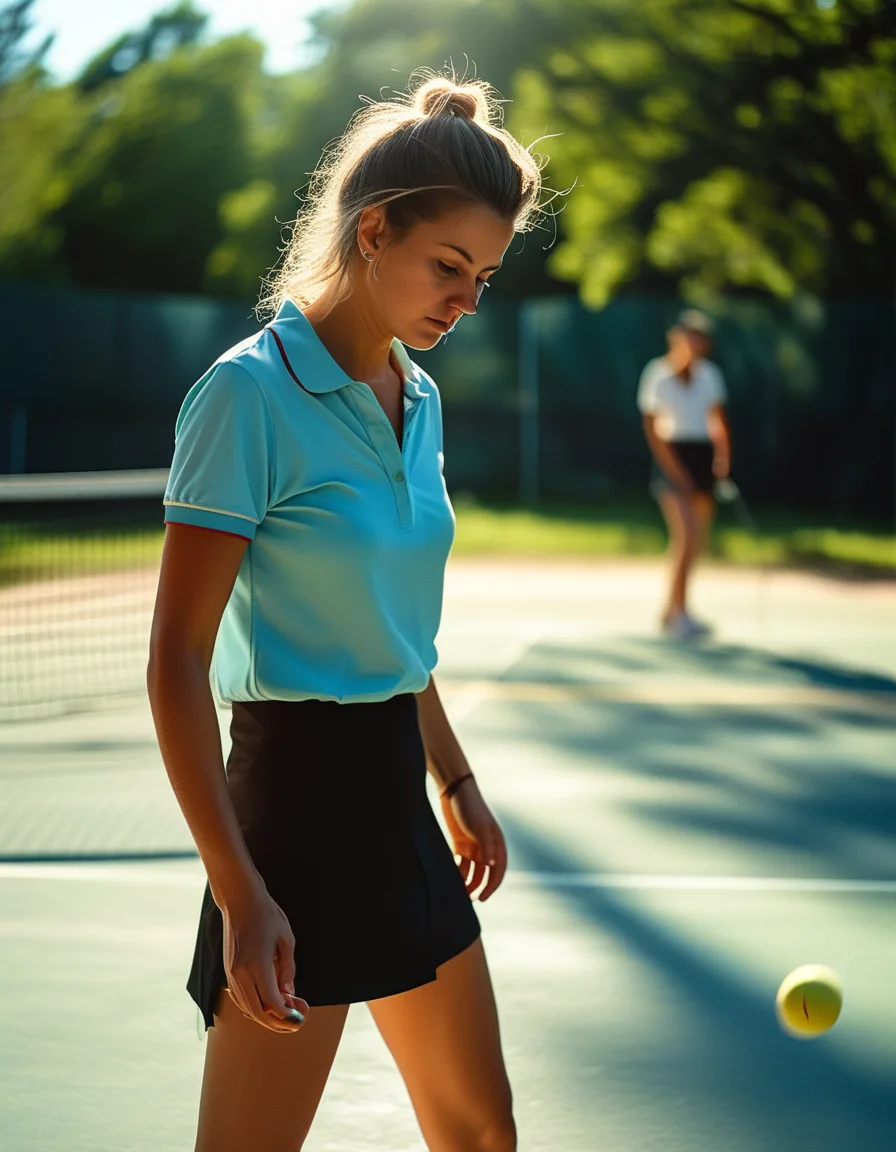
Seen here: UPF 50+ Pleated Running Skort with 26” Leggings & Pockets — shop similar styles on bubblelime.com
Keep Reading
This article is for general informational and styling purposes only. Fit, sizing, and product availability may vary.