The Real Cause of Pickleball Elbow, and Why Grip Size Is Usually the Actual Fix
Quick Answer: Pickleball elbow (a form of lateral epicondylitis similar to tennis elbow) is driven primarily by repetitive eccentric strain on the wrist extensor tendons at the elbow, and while overall volume of play is a real contributing factor, an incorrectly sized paddle grip is one of the most common and correctable root causes, since a grip that’s too small forces excessive forearm muscle engagement on every shot — proper grip sizing, technique adjustments, and a structured eccentric strengthening program together address the actual mechanism far more effectively than rest alone.
Pickleball elbow getting written off as simple overuse misses the more useful, more fixable explanation — in many cases, the actual mechanical trigger is a paddle grip that’s the wrong size for the player’s hand, and that’s a problem equipment changes and technique adjustments can directly solve.

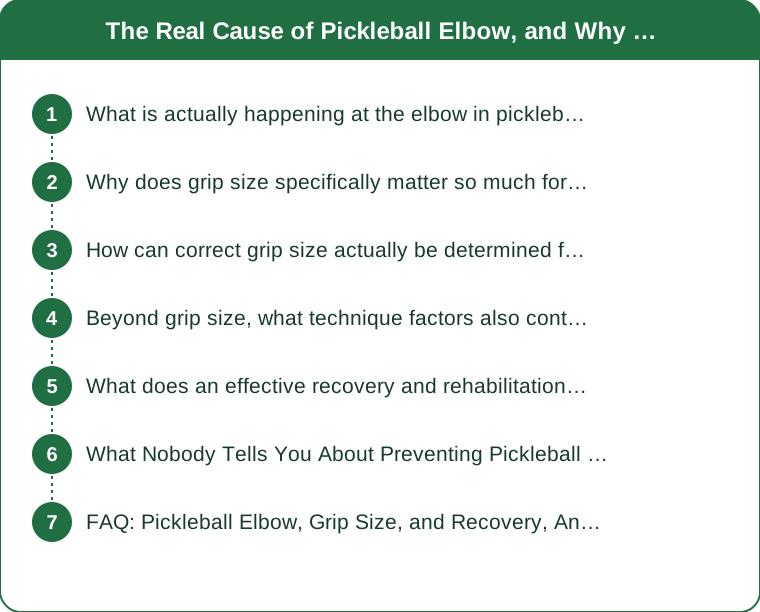
What is actually happening at the elbow in pickleball elbow, mechanically?
Pickleball elbow is a form of lateral epicondylitis, involving microscopic tears and degeneration in the tendons that attach the wrist extensor muscles to the bony bump on the outside of the elbow (the lateral epicondyle). Every time the wrist extends or stabilizes against force during a shot — particularly on off-center hits or backhand shots — these tendons experience repetitive eccentric loading, meaning the muscle-tendon unit lengthens under tension rather than simply contracting, and this specific type of loading is well-documented as more damaging to tendon tissue over repeated exposure than concentric loading alone.
Unlike an acute injury with one clear traumatic moment, this is a cumulative overuse injury pattern, where each individual shot contributes a small amount of microtrauma that the tendon doesn’t fully repair before the next exposure, gradually building toward a symptomatic, often quite painful, injury.
Why does grip size specifically matter so much for this injury, more than just “playing less”?
A grip that’s too small for the hand forces the forearm flexor and extensor muscles to work significantly harder to maintain paddle control on every single shot, since a small grip circumference requires more active muscular gripping force to prevent the paddle from twisting in the hand on contact. This chronically elevated forearm muscle engagement directly increases the cumulative load on exactly the wrist extensor tendons that lateral epicondylitis affects — essentially, an undersized grip adds a meaningful multiplier to every shot’s tendon stress, regardless of how many total shots are played.
Many recreational players default to a smaller grip size, sometimes because it was the only size tried, or because a smaller grip is often (incorrectly) associated with more paddle “feel” or control — but for anyone experiencing or wanting to prevent elbow pain specifically, grip sizing deserves the same attention as technique or training volume, not less.
How can correct grip size actually be determined for an individual player’s hand?
A commonly used measurement method involves measuring from the tip of the ring finger to the second-most-prominent horizontal crease of the palm, which correlates reasonably well with an appropriately fitted grip circumference for most players. Beyond this initial measurement, a practical fit test involves holding the paddle in a normal grip and checking whether there’s roughly a finger’s width of space between the fingertips and the base of the palm when wrapped around the handle — too little space suggests too small a grip, and too much suggests too large.
Many paddle brands also offer overgrip wraps as an easy, low-cost way to incrementally increase effective grip size without needing to buy an entirely new paddle, which makes correcting an undersized grip one of the more accessible fixes available to a player already experiencing symptoms.

Beyond grip size, what technique factors also contribute meaningfully to this injury?
Leading shots with a bent, rather than firm, wrist — particularly on backhand shots — significantly increases the eccentric load on the wrist extensor tendons compared to a technique that keeps the wrist more stabilized and lets the shoulder and larger arm muscles generate more of the shot’s power. Off-center paddle contact, where the ball strikes away from the paddle’s ideal “sweet spot,” also transmits substantially more vibrational shock through the wrist and elbow than a well-centered hit, compounding the cumulative tendon stress over a session.
Working with a coach or experienced player to specifically review backhand mechanics and contact consistency can meaningfully reduce this technique-driven contribution, independent of any grip size correction.
What does an effective recovery and rehabilitation approach for existing pickleball elbow actually involve?
Eccentric strengthening exercises specifically targeting the wrist extensors — commonly a slow, controlled wrist-extension lowering movement using a light dumbbell — are one of the most well-supported rehabilitation approaches for lateral epicondylitis generally, since they build the tendon’s capacity to tolerate the same eccentric loading pattern causing the injury in the first place. This is typically combined with a temporary reduction in play volume, ice for acute symptom management, and addressing the grip size and technique factors above so the same mechanical trigger isn’t simply reintroduced once symptoms improve.
A forearm counterforce brace (a strap worn just below the elbow) can also provide some symptomatic relief during the recovery period by slightly redistributing load away from the injured tendon attachment point, though it’s generally considered a symptom-management tool alongside, not a replacement for, the underlying grip, technique, and strengthening corrections.
What Nobody Tells You About Preventing Pickleball Elbow Long-Term
Paddle weight and swing weight matter alongside grip size, and a heavier paddle than a player’s forearm strength comfortably supports compounds the same overuse mechanism, even with a well-fitted grip — many players focused entirely on grip size overlook that an unnecessarily heavy or head-heavy paddle for their current forearm strength adds a separate, additive strain factor. For players with a history of elbow pain, testing a lighter paddle alongside grip correction, rather than assuming grip size alone will fully resolve the issue, often produces a more complete and durable fix.
FAQ: Pickleball Elbow, Grip Size, and Recovery, Answered
How long does pickleball elbow typically take to resolve with proper treatment?
Mild cases often improve within four to six weeks with consistent eccentric strengthening and load management, though more established or severe cases can take several months, and persistent cases warrant evaluation by a physical therapist or sports medicine provider.
Is it necessary to stop playing entirely during recovery, or can play continue at reduced volume?
Many rehabilitation approaches favor reduced volume and modified technique over complete rest, since some controlled loading actually supports tendon healing, though this should be balanced against symptom severity and ideally guided by a healthcare provider.
Does switching to a different paddle material or surface texture affect elbow strain, separate from grip size and weight?
Some players report that paddles with more built-in vibration dampening reduce the shock transmitted through off-center hits specifically, which can be a secondary contributing factor worth considering alongside the primary grip size and weight adjustments. This is general information, not medical advice.
TL;DR:
- Pickleball elbow involves repetitive eccentric strain on the wrist extensor tendons at the elbow
- An undersized paddle grip forces excessive forearm engagement on every shot, meaningfully raising tendon stress
- Correct grip sizing can be measured directly and adjusted cheaply with an overgrip wrap
- Eccentric strengthening exercises, combined with grip and technique correction, address the root mechanism directly
Pickleball elbow responding well to grip size correction isn’t a coincidence — it’s addressing the actual mechanical trigger directly, which is far more effective long-term than rest alone or reducing play volume without changing the underlying cause. This is general information, not medical advice.
See It in Motion
Seen here: UPF 50+ Pleated Running Skort with 26” Leggings & Pockets — shop similar styles on bubblelime.com
Keep Reading
This article is for general informational and styling purposes only. Fit, sizing, and product availability may vary.