Why Wind Changes Pickleball More Than Any Other Condition
Quick Answer: Wind affects pickleball more than other racket sports because the ball is light, hollow, and perforated — a combination that gives it a very low mass-to-drag ratio. A moderate breeze can move a pickleball a foot or more off its expected path over the length of a rally shot. The correct adjustments are lower and flatter shots, deeper margins on the downwind side, more patience on the upwind side, and a serve strategy that changes entirely depending on which end you are on.
Players who adjust deliberately gain a substantial edge on windy days, because most opponents will simply keep playing their normal game and losing points they do not understand.

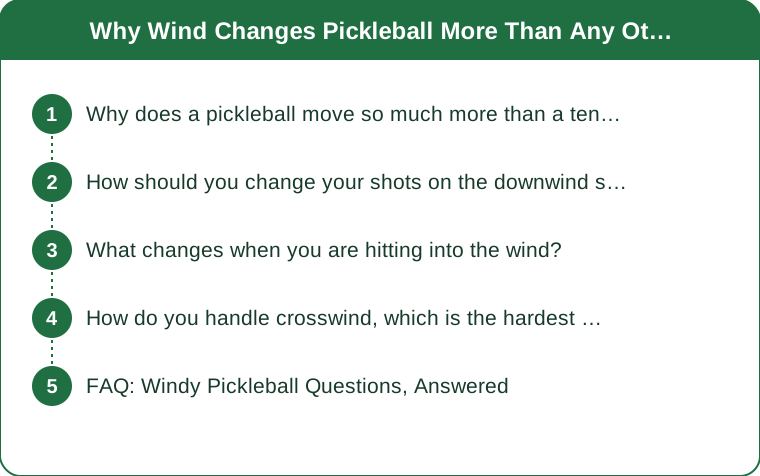
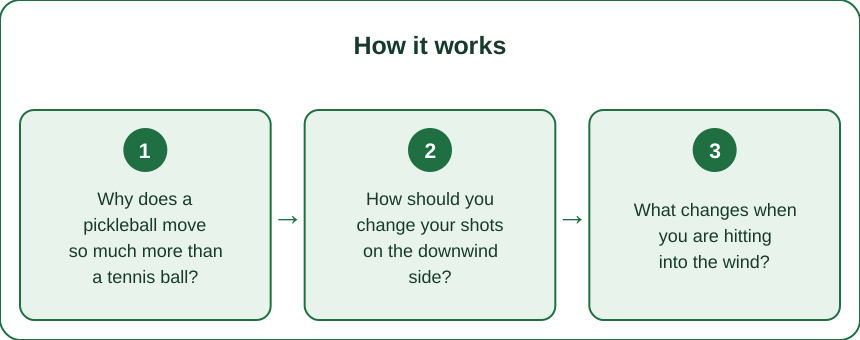
Why does a pickleball move so much more than a tennis ball?
Physics, specifically the ratio between mass and surface drag.
A pickleball weighs roughly 22 to 26 grams. A tennis ball weighs about 58 grams. The pickleball has less than half the mass, so any given aerodynamic force produces more than twice the acceleration.
The holes make it worse. Air passing through and around the perforations creates turbulent flow rather than the smooth boundary layer of a solid ball, which increases drag and makes the ball’s response to crosswind less predictable — it does not just drift, it can move erratically.
And pickleball is slow. A ball that spends more time in the air spends more time being acted on by wind. A soft dink that floats for three quarters of a second in a 10 mph crosswind can arrive somewhere quite different from where it was aimed.
The combination means that the shots most central to pickleball strategy — the dink, the third shot drop, the lob — are precisely the shots most vulnerable to wind. Hard drives are the least affected, which inverts the normal strategic hierarchy.
That inversion is the whole story of playing well in wind. The soft game, which usually wins, becomes a liability. The drive game, which usually loses to good players, becomes viable.
How should you change your shots on the downwind side?
Take pace off and aim shorter than feels right.
With the wind at your back, every ball carries further than your muscle memory expects. The most common downwind error is hitting a normal-feeling third shot drop that sails past the kitchen line and sits up as a putaway.
Reduce your target depth by roughly two to three feet. Aim your drops to land at the front of the kitchen rather than the middle. If they come up slightly short, you have lost very little; if they sail long, you have lost the point.
Dinks are the hardest shot downwind. A dink needs to clear the net and drop immediately, and a following wind fights the drop. The fix is more topspin and less pace — topspin makes the ball dip, which is precisely the correction the wind is undoing.
Serves downwind should be hit with margin, not power. The wind is already adding depth; adding your own power turns a good serve into a fault. Many strong players hit a deliberately softer, higher-percentage serve downwind and save aggression for the other end.
And lobs downwind are close to unplayable — they carry long almost every time. Take the lob out of your game entirely on the downwind side. It is the single highest-percentage strategic adjustment available.

What changes when you are hitting into the wind?
You gain permission to be aggressive, and you need to commit.
Into the wind, the ball drops earlier and dies faster. A shot hit with normal pace will land short, which means drops fall into the net and drives sit up in the kitchen.
Add pace and hit through the ball. Into-the-wind conditions are where you can drive with much less risk than usual, because the wind will bring the ball down before it goes long. Players who keep trying to finesse into a headwind spend the whole match hitting into the net.
Drops into the wind need to be hit higher and firmer. Aiming for the same trajectory as a calm day produces a net error. Think of it as needing to reach further than the target appears to require.
Serves into the wind can be hit hard with far less risk of going long. This is the end to be aggressive on serve — deep, hard, and to the backhand.
And this is the end where the lob genuinely works. A lob into the wind holds up, drops steeply, and is extremely difficult to track. It is one of the few shots that becomes better in wind rather than worse, and almost nobody uses it deliberately.
The overall pattern is worth stating clearly: be patient and soft downwind, aggressive and firm upwind. Most players instinctively do the opposite, because a downwind ball feels powerful and an upwind ball feels weak.
How do you handle crosswind, which is the hardest case?
By changing where you stand, not just how you hit.
Crosswind pushes the ball laterally through the whole flight, which means your aim point has to move. Aim into the wind by roughly the amount you expect the drift to be — typically one to three feet on a moderate day, more on a strong one.
The bigger adjustment is positional. In a crosswind, one sideline becomes far more dangerous than the other, because balls drift toward it. Shift your court coverage a step toward the downwind sideline and give your partner clear communication about it, because the poach dynamics change.
Crosswind also affects the ball differently depending on its spin. A ball with sidespin can be pushed dramatically or barely at all depending on the interaction, which is why crosswind days produce so many balls that look wrong in flight.
The practical response for most players is to simplify. Fewer angles, more shots down the middle, less spin. The middle of the court has the largest error margin in every direction, and on a crosswind day that margin is what you are playing for.
And take note of gusts specifically. Steady wind can be compensated for; gusty wind cannot. On gusty days, the highest-percentage play is to raise net clearance across the board and accept that some balls will sit up. Trying to play precise pickleball in gusts is how good players lose to patient ones.
FAQ: Windy Pickleball Questions, Answered
Should I change my paddle in wind?
No meaningful benefit. Paddle weight affects your swing, not the ball’s flight after contact. Focus adjustment on shot selection and target depth instead.
Do outdoor balls handle wind better than indoor balls?
Yes, noticeably. Outdoor balls are heavier with smaller, more numerous holes, specifically to reduce wind effect. Playing an indoor ball outdoors on a breezy day is close to unplayable.
Which end should I take if I win the toss on a windy day?
Generally start on the upwind side, where you can serve aggressively and build a lead early. Conditions often ease later in a match as afternoon thermals settle, which means the downwind disadvantage may be smaller in the second half.
Does wind favour one style of player?
Strongly. It favours drivers and patient resetters over finesse players, and it favours anyone who adjusts deliberately over anyone who does not. On windy days the biggest edge is simply having thought about it in advance.
TL;DR:
- A pickleball is light and perforated, so wind moves it far more than a tennis ball.
- Downwind: shorter targets, more topspin, softer serves, no lobs.
- Upwind: more pace, firmer drops, aggressive serves, and lobs become a genuine weapon.
- Crosswind: aim into the drift, shift a step toward the downwind sideline, and simplify.
Next breezy session, pick one adjustment per end and stick to it for a full game. Most opponents will still be playing their calm-day game, and that gap is the whole match.
See It in Motion
Seen here: UPF 50+ Pleated Running Skort with 26” Leggings & Pockets — shop similar styles on bubblelime.com
Keep Reading
This article is for general informational and styling purposes only. Fit, sizing, and product availability may vary.