Why You Keep Getting Lobbed: The Complete Guide
Quick Answer: You get lobbed because you stand too close to the kitchen line with your weight forward, you watch the ball instead of the opponent’s paddle, and your partner does not switch with you. Reading the lob from the paddle face two-tenths of a second earlier matters more than any amount of foot speed.
It happens three times a game. The ball goes up, you turn, you chase, and either you never reach it or you flip up a weak return that ends the point anyway. The frustrating part is that you saw it coming — just not quite soon enough. That gap is the whole subject of this article.

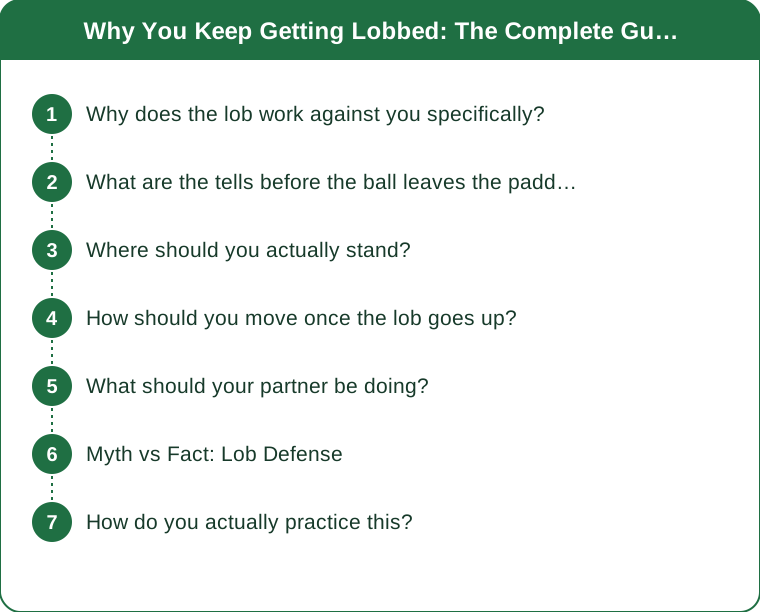
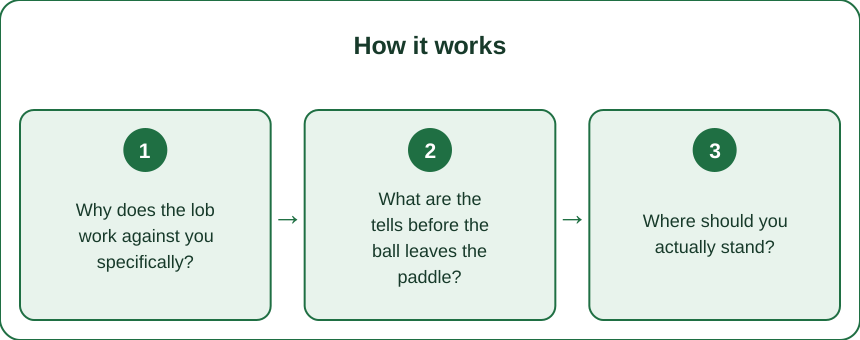
Why does the lob work against you specifically?
The lob is a positional exploit, not a power shot. It works when the geometry is on the lobber’s side, and there are three things that put it there.
You are hugging the kitchen line. Good pickleball instruction pushes players to the non-volley zone line aggressively, and rightly so — that is where points are won. But at the line, you have the entire court behind you and no time buffer. A lobber only has to clear your paddle by a couple of feet.
Your weight is forward. At the kitchen you are leaning in, on the balls of your feet, ready to volley. Reversing that momentum to run backward takes a beat, and a beat is the entire margin on a lob.
You are watching the ball, not the paddle. By the time the ball tells you it is a lob, it is already six feet above you. The paddle told you two-tenths of a second earlier, and at a full sprint, two-tenths is roughly two feet of court.
That last point is the one that separates players who get lobbed constantly from players who rarely do. It is a reading skill, and it is learnable. The players who never seem to get lobbed are not faster. They started moving earlier.
What are the tells before the ball leaves the paddle?
A lob requires a fundamentally different swing than a dink, and the differences are visible if you know where to look.
The paddle face opens. A dink is struck with a relatively closed or neutral face. A lob needs loft, so the face tilts upward noticeably in the backswing. This is the single most reliable tell.
The backswing gets longer and lower. A dink is a short push from a compact position. A lob needs to generate height, which requires the paddle to drop below the ball and swing up through a longer arc.
The knees bend more. Lifting a ball high demands a low-to-high path, and that starts with the legs.
The shoulders turn slightly more. A dink is played almost square. A lob usually shows a bit more rotation.
The contact point moves back. A lobber takes the ball a little later, deeper in their stance, to get under it.
Train yourself to watch the opponent’s paddle and hands rather than the ball during dink exchanges. It feels wrong at first, because everything in your sporting history says to watch the ball. But in a dink rally the ball is moving slowly and predictably; the information is in the paddle.
Where should you actually stand?
The instinct after getting lobbed is to back off the kitchen line. This is usually the wrong correction, and it costs you far more points than the lobs did.
The kitchen line is where the game is won, and retreating to no-man’s land — the area between the kitchen and the baseline — is the worst position on the court. You get the disadvantages of both positions and the advantages of neither.
The correct adjustment is subtler. Keep your toes at the line but shift your weight to a neutral, athletic base rather than leaning forward. Feet roughly shoulder width, knees soft, weight over the middle of the foot rather than the toes. From there you can move forward or backward with equal ease.
Against a known lobber, take a half step back — six to twelve inches, not three feet. That small buffer preserves nearly all of your kitchen advantage while meaningfully improving your ability to turn and run.
One more positioning detail people miss: face slightly sideways rather than square to the net. A staggered, semi-open stance lets you pivot and run backward far faster than a square stance does, because you are not fighting your own hips to turn.
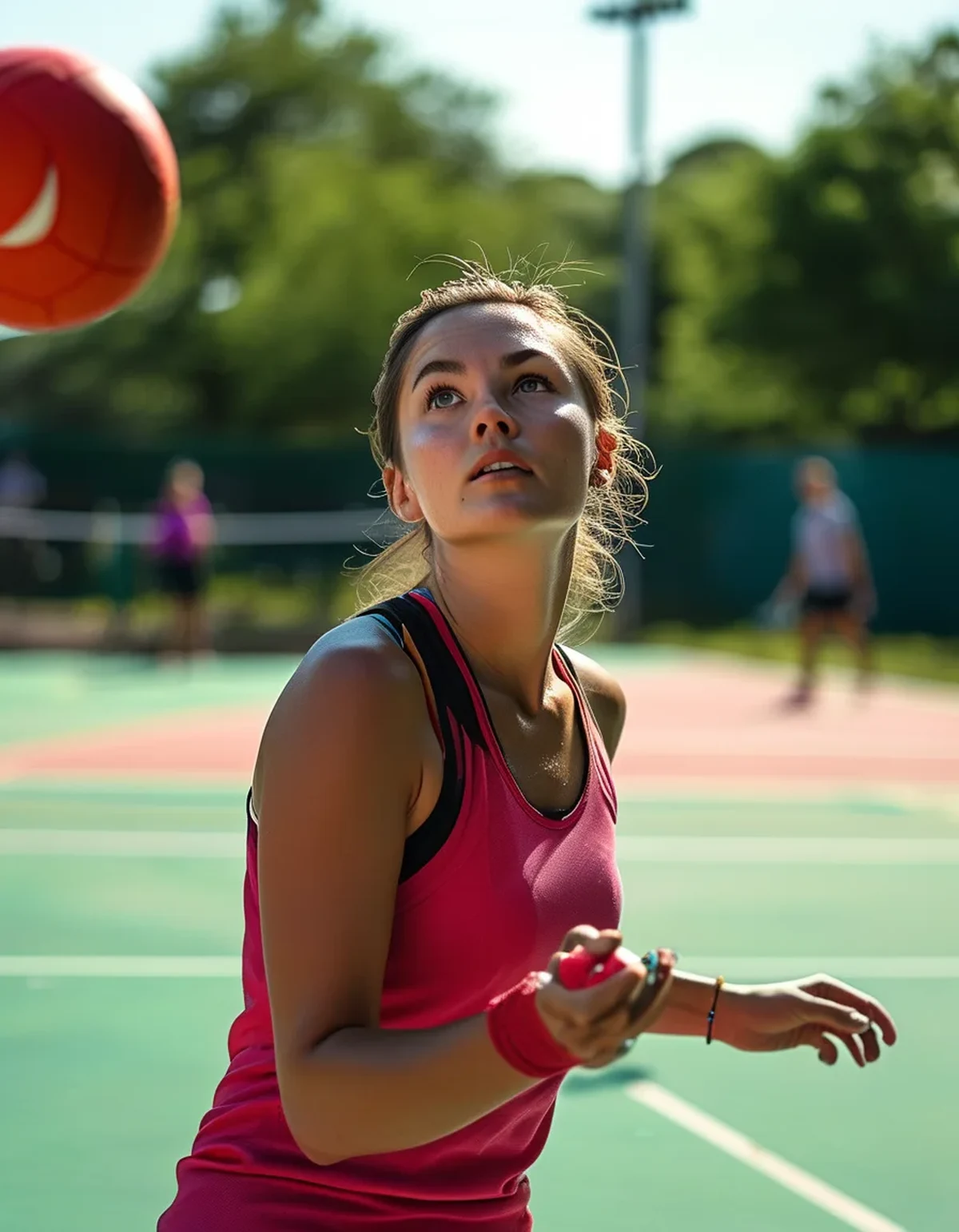
How should you move once the lob goes up?
There is a right technique and a wrong one, and almost everyone starts with the wrong one.
Wrong: backpedaling while facing the net. It is slow, it is unstable, and it is genuinely dangerous — backward falls in pickleball produce a meaningful share of the sport’s serious injuries, particularly wrist and head injuries.
Right: turn your hips and run. Drop the foot on the side the ball is going toward, pivot, and run sideways or with your back partly to the net, tracking the ball over your shoulder. This is the crossover step that tennis players use, and it is roughly twice as fast as backpedaling.
The sequence: read, turn, run, then look. Most players try to keep their eyes locked on the ball throughout, which forces the slow backpedal. Trust your first read, turn and go, then pick the ball up again once you are moving.
When you get there, be realistic about the shot. If you are behind the ball with balance, hit an overhead. If you are stretched or off-balance, hit a high, deep defensive lob back rather than attempting a winner. Buying time to recover position beats attempting a low-percentage response from a bad platform.
What should your partner be doing?
This is where most recreational teams lose the point that the lob started, and the fix is a single sentence spoken out loud.
When a lob goes over one player, that player runs back. Their partner must switch to the other side. If both players end up on the same half of the court, the return comes back into an empty half and the point is over regardless of how well the lob was chased.
The standard call is a single word — most teams use “switch” or “you” — shouted by the player chasing, or by the partner who can see the whole court. Agree on the word before the game, not during.
The partner who is not chasing has a second job: retreat slightly toward the middle and back off the kitchen a step, because a defensive lob return is likely coming and the opponents will be attacking it. Standing frozen at the kitchen line while your partner scrambles is how a recoverable point becomes a lost one.
The best teams also agree in advance on who takes lobs down the middle. Usually it goes to the player with the stronger overhead, or to the forehand side. Decide once; do not negotiate mid-point.
Myth vs Fact: Lob Defense
Myth: If you get lobbed a lot, you need to be faster. Fact: Reading the paddle two-tenths of a second earlier is worth more than any realistic improvement in sprint speed. It is a perception skill, and it improves faster than fitness does.
Myth: You should back off the kitchen against lobbers. Fact: Backing up costs you the kitchen advantage on every single point to defend against a shot that comes a few times per game. A half step and a neutral stance is the correct trade.
Myth: Backpedaling is fine if you are careful. Fact: It is both slower and the leading cause of the falls that injure recreational players. Turn and run — always.
Myth: Lobbing back is a defeat. Fact: A high, deep defensive lob is often the correct percentage play from a scrambled position. It resets the point and gives you time to get back to the line.
Myth: Lobs are a beginner tactic. Fact: The lob is used at every level. What changes is disguise — higher-level lobbers hide the tells until the last possible moment, which is exactly why paddle reading matters more as you improve.
How do you actually practice this?
Reading and movement are trainable, and they respond quickly to specific drills.
Drill 1 — Paddle reading, no running. Dink with a partner who randomly lobs one ball in ten. Your only job is to call “lob” out loud the instant you read it. Do not chase. Track your accuracy and how early the call comes. Ten minutes twice a week produces noticeable change within a month.
Drill 2 — Turn and run. Stand at the kitchen. A partner tosses lobs to alternate sides. Practice only the pivot and crossover step, catching the ball rather than hitting it. Build the movement pattern before adding the shot.
Drill 3 — Switch calls. Play points where the only rule is that every lob must be accompanied by a verbal switch call from the defending team. Get the communication automatic in practice so it survives under pressure.
Drill 4 — Overheads from a scramble. Rather than hitting overheads from a comfortable set position, have a partner lob while you are moving. Real overheads are almost never hit from balance, and practicing them from balance builds a skill you will rarely get to use.
Drill 5 — Defensive lob returns. Practice hitting a high deep lob from a stretched position behind the baseline. This is your escape shot, and most players have never deliberately practiced it once.
TL;DR:
- Read the paddle face, not the ball — an open face and a longer, lower backswing are the tells
- Stay at the kitchen but shift to a neutral, semi-open athletic stance and take a half step back against known lobbers
- Turn and run with a crossover step; never backpedal
- Your partner must switch sides and drop back, called out loud with one agreed word
- From a scramble, hit a high deep defensive lob rather than attempting a winner
The reason lobs feel unfair is that they punish the exact position good instruction tells you to take. That does not make the instruction wrong; it means the kitchen line comes with a specific vulnerability that has a specific answer. Spend ten minutes a week on the reading drill and the lob stops being a weapon against you within about a month, without you getting a single step faster.
See It in Motion
Seen here: UPF 50+ Pleated Running Skort with 26” Leggings & Pockets — shop similar styles on bubblelime.com
Keep Reading
This article is for general informational and styling purposes only. Fit, sizing, and product availability may vary.