Why Your Dinks Keep Popping Up High Enough to Get Smashed
Quick Answer: A dink that pops up too high is almost always caused by an upward paddle swing path rather than a forward-and-down one — the fix is shortening the backswing and pushing through the ball with a flatter, more controlled paddle face.
If your dinks keep giving opponents an easy put-away at the net, the problem usually isn’t your reaction time — it’s the shape of your swing.

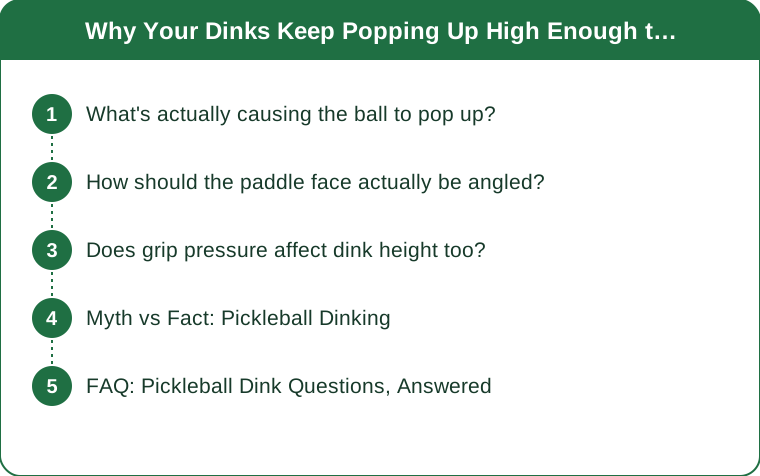
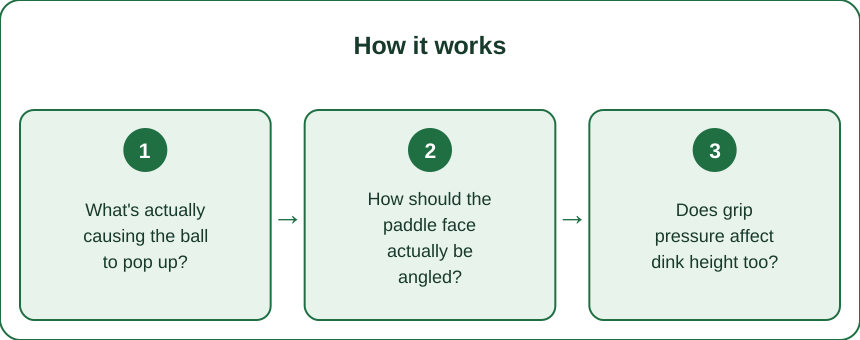
What’s actually causing the ball to pop up?
Most players who struggle with high dinks are unconsciously using an upward brushing motion, similar to a mini version of a topspin groundstroke. The paddle face opens up and the swing path travels upward through contact, which launches the ball higher than intended even at low power. A proper dink uses a much flatter paddle path — more of a gentle push forward than a lift.
How should the paddle face actually be angled?
For a controlled dink, the paddle face should be slightly open — just enough to clear the net with margin — but the swing itself should travel forward and slightly downward through contact, not upward. Think of guiding the ball rather than lifting it. A helpful mental cue many coaches use is imagining you’re placing the ball gently into a low target, not tossing it.

Does grip pressure affect dink height too?
Yes — a tight, tense grip transfers more unintended force into the ball on contact, which can cause even a well-angled paddle face to send the ball higher than planned. Loosening grip pressure to roughly a 3 or 4 out of 10 gives you finer control over how much pop the ball gets off the paddle, which is exactly what a soft, low dink requires.
Myth vs Fact: Pickleball Dinking
Myth: A higher-arcing dink is safer because it clears the net by more. Fact: Height gives your opponent more time to set up an aggressive attack — low and controlled beats high and floaty.
Myth: Dinking is just a slower version of a regular shot. Fact: It uses a fundamentally different swing path — forward and down, not up — not simply a toned-down groundstroke.
Myth: Wrist snap adds helpful control to dinks. Fact: Most consistent dinkers minimize wrist movement, relying on a stable paddle face and arm-driven push instead.
FAQ: Pickleball Dink Questions, Answered
How low should a good dink actually travel over the net?
Most coaches suggest aiming for roughly 6-12 inches of clearance over the net at its peak — enough margin for safety without giving your opponent an easy attacking height.
Should I bend my knees more to fix popping-up dinks?
Yes, often — staying too upright forces you to lift the paddle to reach low balls, which contributes to the upward swing path that causes popping. Bending your knees lets you meet the ball with a flatter paddle angle.
How long does it take to fix a habitual high dink?
With focused practice — even just 10-15 minutes of dedicated dinking drills per session — most players notice real improvement within 2-3 weeks.
TL;DR:
- High dinks usually come from an upward swing path, not weak technique overall
- Push the paddle forward and slightly down through contact, not up
- Loosen your grip pressure for finer control over ball pop
- Bend your knees to meet low balls with a flatter paddle face
Next practice session, film a few dinks from the side — you’ll see the swing path clearly, and that’s the fastest way to correct it.
See It in Motion
Seen here: UPF 50+ Pleated Running Skort with 26” Leggings & Pockets — shop similar styles on bubblelime.com
Keep Reading
This article is for general informational and styling purposes only. Fit, sizing, and product availability may vary.