Why Your Third Shot Drop Keeps Landing Short or Long, Never in the Kitchen
Quick Answer: A third shot drop that consistently misses short or long, rather than landing in the kitchen, usually comes down to inconsistent paddle face angle and swing speed relative to distance from the net, combined with trying to muscle the shot with the arm instead of using a soft, controlled lifting motion from the legs and core — both fixable with deliberate slow-motion practice rather than repetition at full pace alone.
A drop that lands in the net or sails past the kitchen isn’t bad luck — a consistent short-or-long miss pattern points to one or two specific, correctable technical habits.
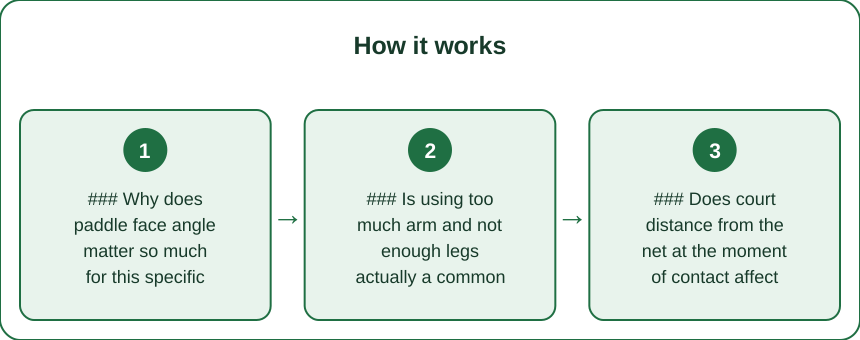
### Why does paddle face angle matter so much for this specific shot?
The third shot drop requires enough upward angle on the paddle face to arc the ball over the net while still landing it softly in the kitchen, and even a few degrees of inconsistency in that angle from swing to swing — often driven by wrist position drifting under pressure — is enough to push the ball into the net (too flat) or sailing long (too much lift combined with too much power).
### Is using too much arm and not enough legs actually a common cause of this specific miss pattern?
Yes, very commonly — an arm-dominant swing tends to produce inconsistent power and touch shot to shot, since the arm alone struggles to reliably reproduce the same soft, controlled force needed for this shot, while incorporating a gentle push from the legs and a stable core creates a more repeatable, consistent motion less prone to the swing-to-swing power variation that causes short or long misses.
### Does court distance from the net at the moment of contact affect this consistency?
Yes significantly — the third shot drop is typically hit from roughly mid-court, and the required paddle angle and swing speed change meaningfully depending on exact distance from the net at contact, meaning a player still working out their positioning is also fighting a moving target for the correct swing calibration on top of the technique itself, compounding inconsistency.
### Why do many players say this shot only clicks after a specific kind of practice, not just general play?
General rally play typically doesn’t offer enough repetition of this exact shot from a consistent distance and pace to build true muscle memory — dedicated, repetitive third shot drop drilling from a fixed position, without the variability of live point play, is widely considered by coaches to be the more effective way to build the specific consistency this shot demands.
### Does grip pressure or contact point on the paddle also affect this consistency?
Yes, both — a tense, tight grip transfers more unpredictable force into the shot and reduces the fine touch control the drop requires, while a relaxed grip (often described as holding the paddle like a bird you don’t want to hurt) allows for more consistent, soft contact. Separately, contact toward the paddle’s sweet spot, roughly centered, produces the most predictable result, while off-center contact — even slightly toward the edge — can meaningfully alter both power and angle in ways that push the shot short or unexpectedly long, adding another layer of inconsistency on top of swing mechanics alone.
### What does an effective practice drill for isolating and fixing this specific shot typically look like?
A common effective drill involves a partner or ball machine feeding balls from a consistent position at the baseline, allowing focused repetition of the drop shot’s specific mechanics — paddle angle, soft leg-driven swing, relaxed grip, centered contact — without the added variability and pressure of live point play, letting a player isolate and correct one variable at a time before reintroducing it to full games.
FAQ: Third Shot Drop Consistency, Answered
How many repetitions of dedicated drop shot practice typically produce noticeable improvement?
Many coaches suggest that consistent, focused practice sessions of 50-100 repetitions per session, done regularly over several weeks, tend to produce meaningfully more consistent results than sporadic practice folded only into regular games.
Is it more effective to focus on fixing paddle angle or swing power first?
Most coaching approaches address paddle angle and soft touch together as the first priority, since power that’s already excessive will overpower even a well-angled paddle face, making the softer, controlled swing the more foundational fix to establish first.
Does this shot get easier as overall pickleball experience increases, even without dedicated drilling?
Somewhat, but dedicated, isolated practice generally produces faster and more reliable improvement specifically for this shot than general match-play experience alone, since the third shot drop’s exact mechanics don’t get enough consistent repetition in typical variable point play.
TL;DR:
- A short-or-long miss pattern on the third shot drop usually points to inconsistent paddle angle and an arm-dominant swing
- Using the legs and core for a soft, controlled motion produces more repeatable results than an arm-only swing
- Distance from the net at contact changes the needed swing calibration, adding difficulty during live play specifically
- Dedicated, isolated drilling from a fixed position builds this shot’s specific consistency faster than general match play alone
Next practice session, isolate this shot with dedicated repetition from a fixed spot before folding it back into live points — most short-or-long patterns resolve faster through focused drilling than through match play alone.
See It in Motion
Seen here: UPF 50+ Adjustable A-Line Running Skort with Pockets — shop it on bubblelime.com
Keep Reading
This article is for general informational and styling purposes only. Fit, sizing, and product availability may vary.